
What to Sell on Shopify: 30 Product Ideas for Beginners
Deciding what to sell on Shopify is not about finding one secret product that guarantees sales. A better product gives a specific customer a clear reason to buy, leaves enough margin after every cost, and can be sourced, shipped, explained, and supported reliably.
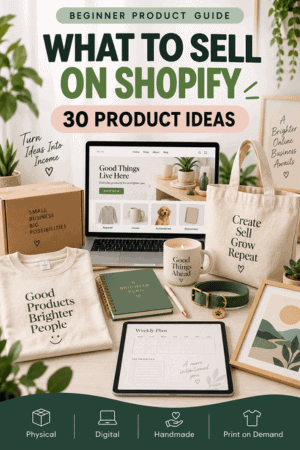
This guide gives you 30 Shopify product ideas across physical products, handmade goods, print on demand, digital downloads, subscriptions, and services. More importantly, it explains how to evaluate each idea before you invest in inventory, apps, packaging, or advertising.
If you are ready to test an idea while following this guide, you can start building your Shopify store and keep it protected until the product, pricing, policies, checkout, and fulfillment process have been tested.
Product, platform, and research information was reviewed October 14, 2026. Demand, competition, costs, laws, supplier terms, app availability, and Shopify promotions can change. Validate the idea for your market before spending money.
Key Takeaways
- Choose a customer and problem before choosing a product catalog.
- Validate demand with customer conversations, search behavior, competitor research, and a small real-world test.
- Calculate contribution after product cost, shipping, payment expenses, packaging, returns, apps, discounts, and marketing.
- Beginners usually benefit from a small, related catalog rather than an unfocused general store.
- Samples, original photographs, accurate descriptions, and complete test orders reduce preventable customer problems.
- Products involving food, cosmetics, children, health, electronics, safety, or regulated claims require additional verification.
How to Choose What to Sell on Shopify
Start with the customer. A store for apartment gardeners, new dog owners, traveling photographers, or beginner woodworkers can make clearer product decisions than a store attempting to sell to everyone.
Shopify defines product research as evaluating what to sell, who will buy it, and whether the business is likely to profit. Its current product-research guidance emphasizes demand, competition, customer needs, pricing, differentiation, and testing before a major investment.
If you are planning the entire business rather than only the product, use my guide to starting an online store to work through validation, costs, fulfillment, platform setup, and launch preparation in order.
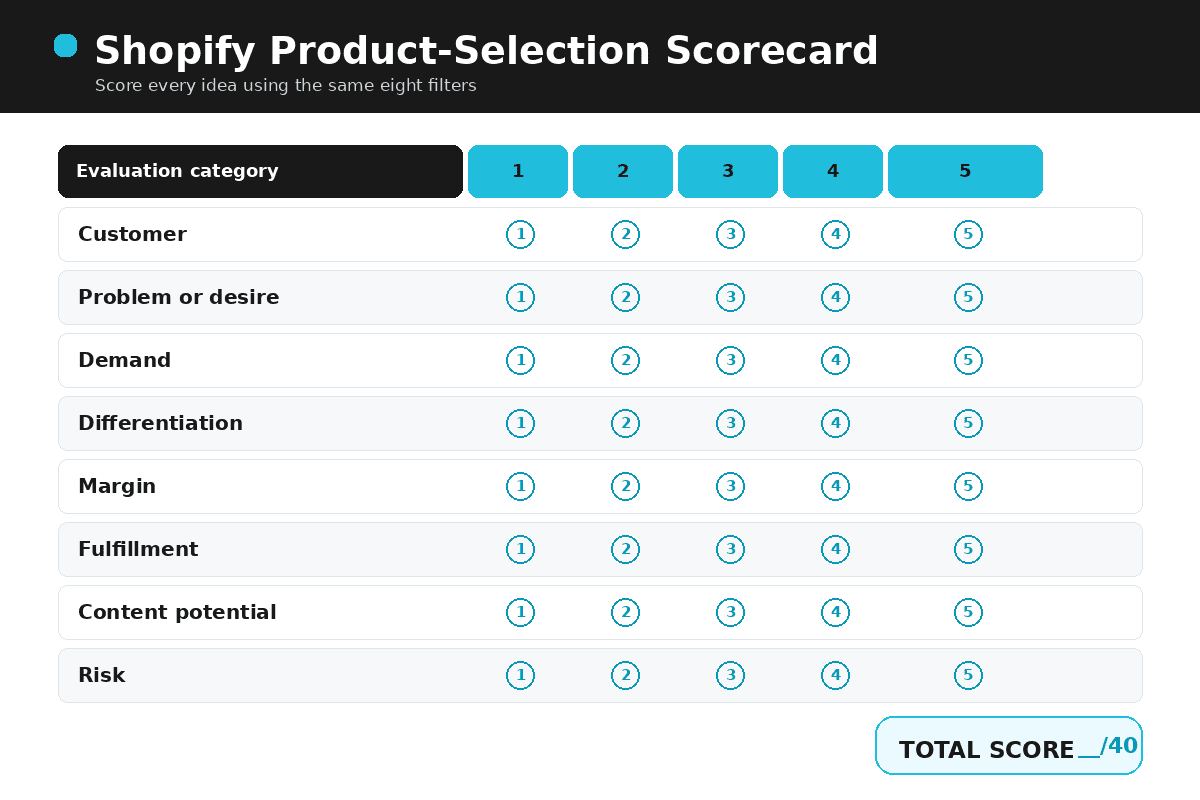
Use These Eight Filters
- Customer: Can you describe who buys it and why?
- Problem or desire: Does it create a useful result, identity, convenience, or experience?
- Demand: Do searches, conversations, communities, sales activity, or preorders show buying interest?
- Differentiation: Why should someone choose your version instead of an established alternative?
- Margin: Is money left after every variable cost and a realistic acquisition cost?
- Fulfillment: Can it be stored, produced, packed, delivered, and returned reliably?
- Content: Can you demonstrate the product through photographs, video, tutorials, comparisons, or customer examples?
- Risk: Are the safety, intellectual-property, labeling, tax, shipping, and advertising obligations manageable?
Before choosing Shopify itself, read my complete Shopify review for the platform’s strengths, limitations, pricing considerations, and best use cases.
30 Product Ideas to Sell on Shopify
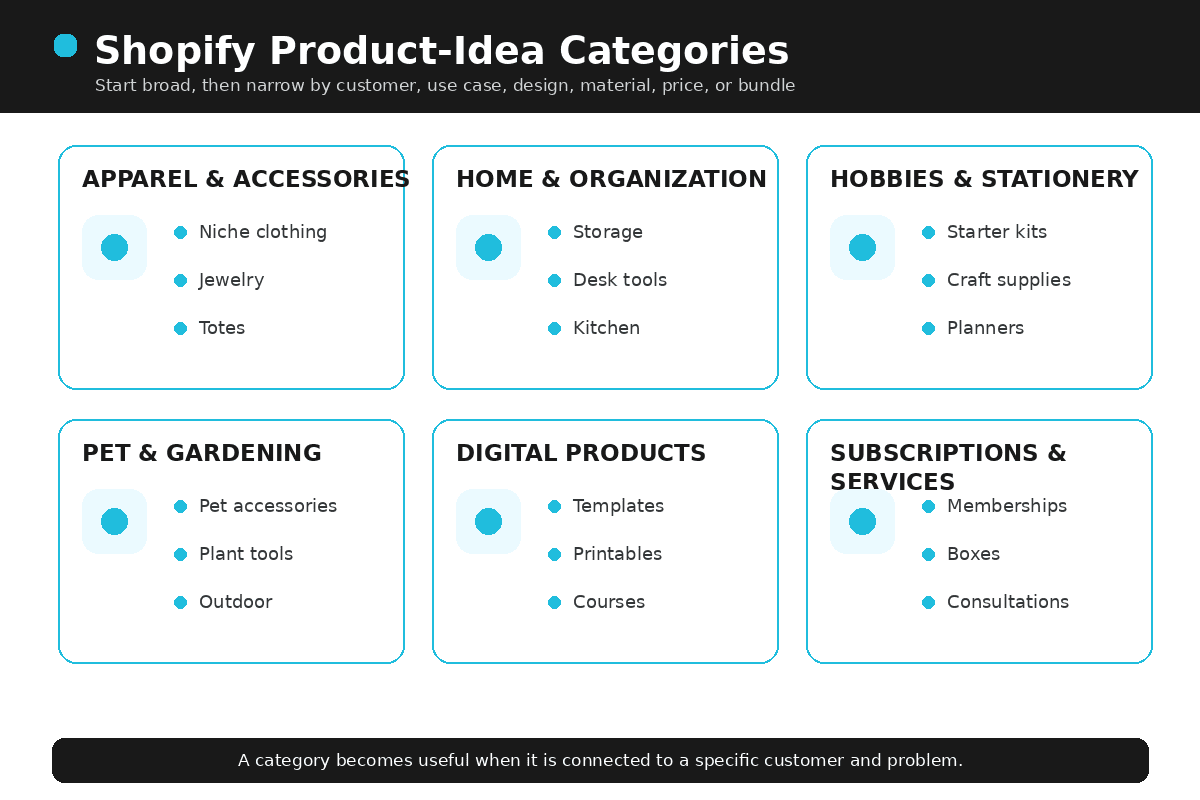
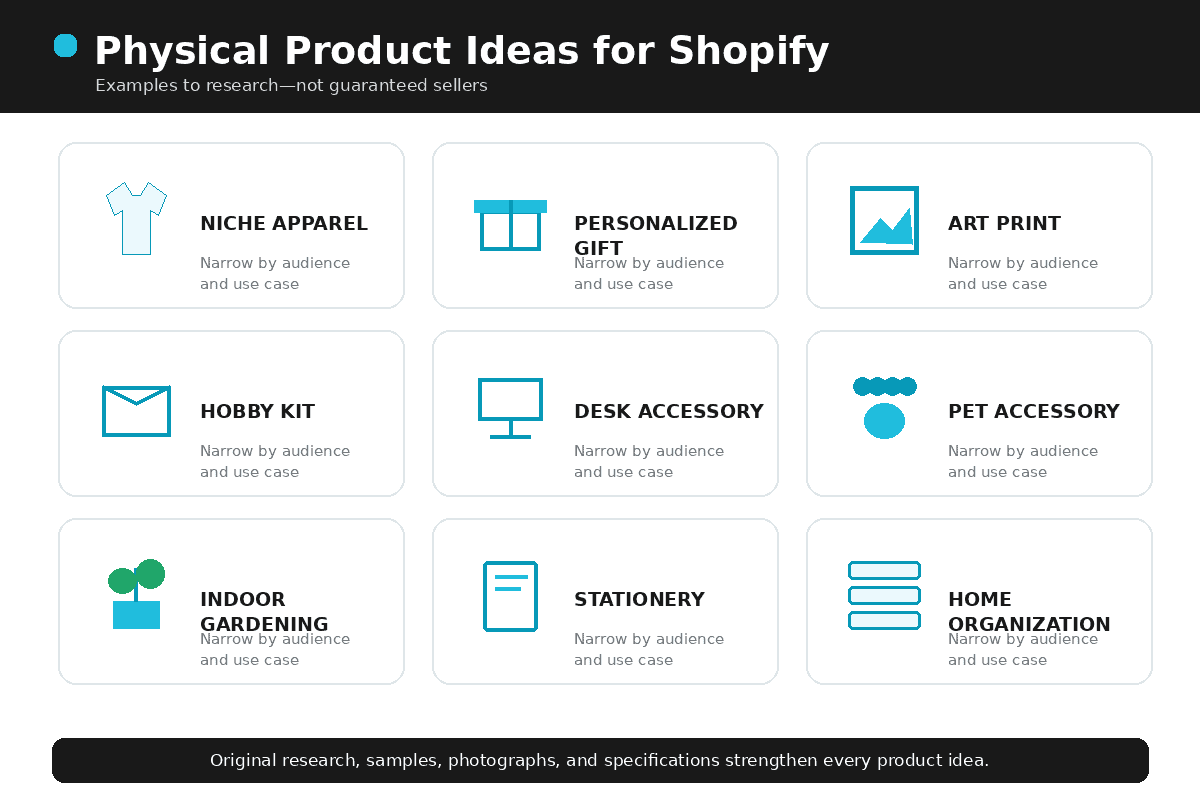
The ideas below are starting points. Narrow each one by audience, use case, design, material, price, bundle, or service experience. “Pet products” is broad; “compact enrichment toys for indoor senior cats” is a position a customer can understand.
1. Niche Apparel
Build apparel around a defined activity, profession, community, fit need, or climate instead of another general clothing store. Examples include trail layers for petite hikers, durable work shirts for mobile groomers, or sensory-conscious basics. Apparel supports visual content and repeat purchases, but sizing, seasonality, inventory, and returns can quickly weaken margins. Validate the fit, fabric, wash performance, and size chart with samples and a small first collection.
2. Personalized Gifts
Personalized gifts can serve weddings, anniversaries, new homes, pets, graduations, memorials, and corporate events. Names, dates, locations, photographs, and custom messages make a familiar product more meaningful. The operational risk is error: one misspelled name or unclear proof can make the item unsellable. Create a clear personalization form, preview process, correction policy, production timeline, and cutoff dates before promoting the product.
3. Print-on-Demand Shirts and Sweatshirts
Original apparel designs can be produced only after a customer orders, reducing the need to buy every size and color upfront. The idea works best when the art speaks to a specific audience instead of relying on generic slogans. Order samples of every garment family, verify printing and sizing, and confirm that you own or license the artwork. My Shopify print-on-demand guide covers provider selection, samples, pricing, and fulfillment.
4. Art Prints and Posters
Artists, photographers, illustrators, mapmakers, and designers can sell open-edition or limited-edition prints. A coherent subject—local architecture, botanical art, travel memories, or children’s rooms—gives the store a reason to exist. Show framing examples and accurate dimensions so buyers understand scale. Test paper, color accuracy, packaging, corner protection, and international shipping before expanding the catalog.
5. Tote Bags and Everyday Carry Accessories
Totes, pouches, organizers, and lightweight carry accessories can target commuters, teachers, parents, travelers, hobbyists, or event attendees. Differentiation can come from pocket layout, washable material, personalization, original art, or a carefully designed bundle. Demonstrate what fits inside, photograph the product in use, and test seams, straps, zippers, weight capacity, and wash instructions rather than relying on supplier claims.
6. Specialty Jewelry
Jewelry becomes more defensible when it has a clear design language, material story, personalization option, or audience. Examples include minimalist birth-flower pieces, accessible clasps, locally inspired designs, or lightweight statement earrings. Publish accurate dimensions and materials, avoid unsupported allergy claims, and verify plating, clasps, stones, packaging, and wear through samples. Photograph scale on a person whenever possible.
7. Hobby Starter Kits
Starter kits reduce the confusion of buying supplies separately. A beginner embroidery kit, miniature-painting kit, home coffee-tasting kit, or nature-journaling set can combine products with instructions. The value is curation and education, so the guide must be genuinely helpful. Confirm component safety, age suitability, replacement availability, packaging, and the total packed weight. Test the project with a true beginner before selling it.
8. Craft Supplies
Specialized paper, beads, blanks, fabrics, tools, stamps, molds, and storage can serve repeat buyers who already understand the hobby. A narrow catalog lets you create tutorials and bundles that general marketplaces do not explain well. Keep specifications precise—dimensions, material, color, quantity, compatibility, and skill level. Avoid branded characters or designs unless you have permission to sell them.
9. Home-Organization Products
Drawer systems, cable organizers, labels, pantry tools, small-space storage, and travel organizers solve visible problems that are easy to demonstrate. Target a specific room or customer instead of selling unrelated bins. Provide exact internal and external measurements, material, installation requirements, and weight limits. Use before-and-after content carefully so it shows a realistic result rather than a misleading transformation.
10. Desk and Home-Office Accessories
Desk mats, monitor risers, cable tools, laptop stands, pen storage, and focus accessories can serve remote workers, students, designers, or gamers. Create a coordinated system rather than a random accessory store. Confirm device compatibility, dimensions, stability, heat ventilation, surface protection, and assembly. Products that appear in attractive workspace photographs also support Pinterest and search content.
11. Kitchen Organization and Meal-Prep Tools
Container labels, recipe systems, portion tools, lunch accessories, utensil storage, and reusable planning products can solve recurring household problems. Avoid making food-safety, health, or material claims you cannot document. Verify whether items are actually suitable for food contact, dishwashers, freezers, heat, or microwaves. Clear care instructions and exact capacities reduce returns.
12. Reusable Travel Accessories
Packing organizers, refillable containers, document wallets, cable pouches, laundry bags, and compact comfort accessories can be bundled for a particular type of trip. Demonstrate packed size and empty weight because those details matter to travelers. Review airline, liquid, battery, customs, and destination restrictions before making compatibility claims. Durable construction matters more than adding many low-quality items.
13. Pet Accessories
Walking accessories, travel organizers, feeding mats, enrichment products, memorial goods, and breed-specific gifts support emotional and practical buying decisions. Pet size and behavior vary, so publish measurements, materials, supervision instructions, and limitations. Avoid unverified health or safety promises. Test attachment points and durability, and be especially cautious with anything a pet can ingest, chew apart, or become tangled in.
14. Indoor Gardening Accessories
Propagation stations, plant labels, trellises, pot accessories, watering tools, and beginner kits can target apartment gardeners or particular plant types. Educational content can distinguish the store, but growing results vary by light, climate, plant, and care. Be precise about dimensions, materials, drainage, installation, and what is included. Check agricultural and shipping restrictions before selling live plants or soil across regions.
15. Sustainable Household Swaps
Reusable cleaning cloths, refillable dispensers, durable brushes, storage solutions, and low-waste kits can appeal to customers seeking fewer disposables. Sustainability claims need evidence; reusable does not automatically mean environmentally superior in every use. Explain the materials, expected life, care, packaging, and end-of-life options accurately. Avoid vague “eco-friendly” promises that cannot be supported.
16. Specialty Stationery
Notebooks, notepads, calendars, cards, bookmarks, stickers, and correspondence sets can serve teachers, readers, planners, travelers, or particular professions. A recognizable illustration style or functional layout is more defensible than generic paper goods. Test writing tools on the paper, print alignment, binding, packaging, and color accuracy. Seasonal releases can create repeat purchases but require careful production timing.
17. Planners and Tracking Journals
A planner becomes useful when designed around a real workflow: content production, garden maintenance, household projects, freelance clients, reading, or travel. Interview users before designing the pages; more sections do not necessarily create a better planner. Avoid medical or outcome promises. Offer page previews, dimensions, binding details, and an undated option if customers may begin at different times.
18. Digital Templates
Spreadsheet systems, presentation layouts, social-media templates, client forms, printable organizers, and project dashboards have no physical shipping cost. The value comes from saving time or improving a process, not from supplying another generic file. Include instructions, compatibility details, preview images, license terms, accessibility considerations, and a support boundary. Test every link and formula before delivery.
19. Printable Learning Activities
Original worksheets, flash cards, scavenger hunts, classroom games, and activity packs can target a subject, age range, or learning setting. Accuracy, usability, and clear printing instructions matter. Do not copy copyrighted characters, books, worksheets, or curriculum materials. Ask teachers or parents to test the activities, and avoid claims that the product will diagnose, treat, or guarantee a learning outcome.
20. Photography Presets and Creative Assets
Photographers and designers can sell presets, brushes, textures, icons, mockups, stock photographs, or sound effects they created. Show several realistic before-and-after examples and disclose the software, version, file type, and editing knowledge required. A preset will not create identical results across every camera, lighting condition, or image. Provide clear personal and commercial license terms.
21. Ebooks and Practical Guides
A focused guide can package firsthand knowledge into a useful process, such as planning a regional road trip, organizing family recipes, or maintaining a specific hobby tool. Narrow expertise is more valuable than a broad collection of generic information. Verify facts, cite sources where needed, update dated material, and avoid professional promises outside your qualifications. Add worksheets or checklists only when they support the outcome.
22. Online Workshops or Mini-Courses
Live workshops and compact courses can teach a defined skill with demonstrations, assignments, and feedback. Sell a specific transformation that can reasonably be taught, not an exaggerated income or performance guarantee. State the schedule, prerequisites, access period, format, captions, refund terms, and what support includes. A small live cohort can validate the material before you invest in a larger recorded course.
23. Membership Resources
A membership can provide recurring templates, lessons, office hours, community access, research, or project prompts. Recurring revenue is appealing, but members need ongoing value and a simple cancellation process. Test demand with a founding group and a clear publishing schedule. Calculate the time required for moderation, support, content, platform costs, and retention before setting the price.
24. Curated Subscription Boxes
Subscription boxes can serve readers, artists, gardeners, coffee enthusiasts, families, or local-product fans. Curation, discovery, and convenience must justify the recurring price. Model product cost, packaging, shipping zones, damaged items, skips, cancellations, and inventory leftovers for every shipment. Start with a one-time themed box or limited preorder before promising an open-ended subscription.
25. Curated Gift Boxes
One-time gift boxes can address new homes, employee appreciation, recovery, weddings, birthdays, or regional experiences. The store adds value through selection, presentation, personalization, and dependable delivery. Confirm permission to resell every product, keep ingredient and allergy information intact, and plan substitutions before an item becomes unavailable. Photograph the exact box customers will receive.
26. Small-Batch Candles and Home Fragrance
Candles, wax melts, and home-fragrance products support gifting, collections, and strong visual branding. They also create safety, labeling, shipping, breakage, temperature, and insurance considerations. Follow applicable standards, test every vessel and formulation, use appropriate warning labels, document batches, and avoid health claims. A small local test can reveal scent preferences and packaging problems before wider shipping.
27. Handmade Soap and Bath Products
Original soap, bath salts, and simple bath products can be positioned through scent, design, gifting, or a specific routine. Cosmetics and personal-care products may involve labeling, ingredient, facility, safety, insurance, and claim requirements depending on the item and location. Do not imply that a product treats a medical condition without the evidence and authorization required. Research the rules before developing the formula or packaging.
28. Small Wood Products
Desk organizers, shelves, plant stands, display blocks, serving accessories, and personalized signs can turn practical woodworking skills into a focused catalog. Product dimensions, finish, wood variation, mounting, weight, and care should be clear. Account for labor honestly; material cost alone does not determine profit. Build repeatable jigs and packaging before accepting more orders than you can produce safely.
29. Niche Product Bundles
A bundle combines compatible products around one job, such as a new-apartment cable kit, watercolor travel set, puppy-walk organizer, or conference-speaker kit. Bundles can raise order value and reduce decision fatigue, but one unavailable component can stop the entire offer. Verify resale rights, inventory synchronization, packaging, individual safety information, and whether the combined weight destroys the margin.
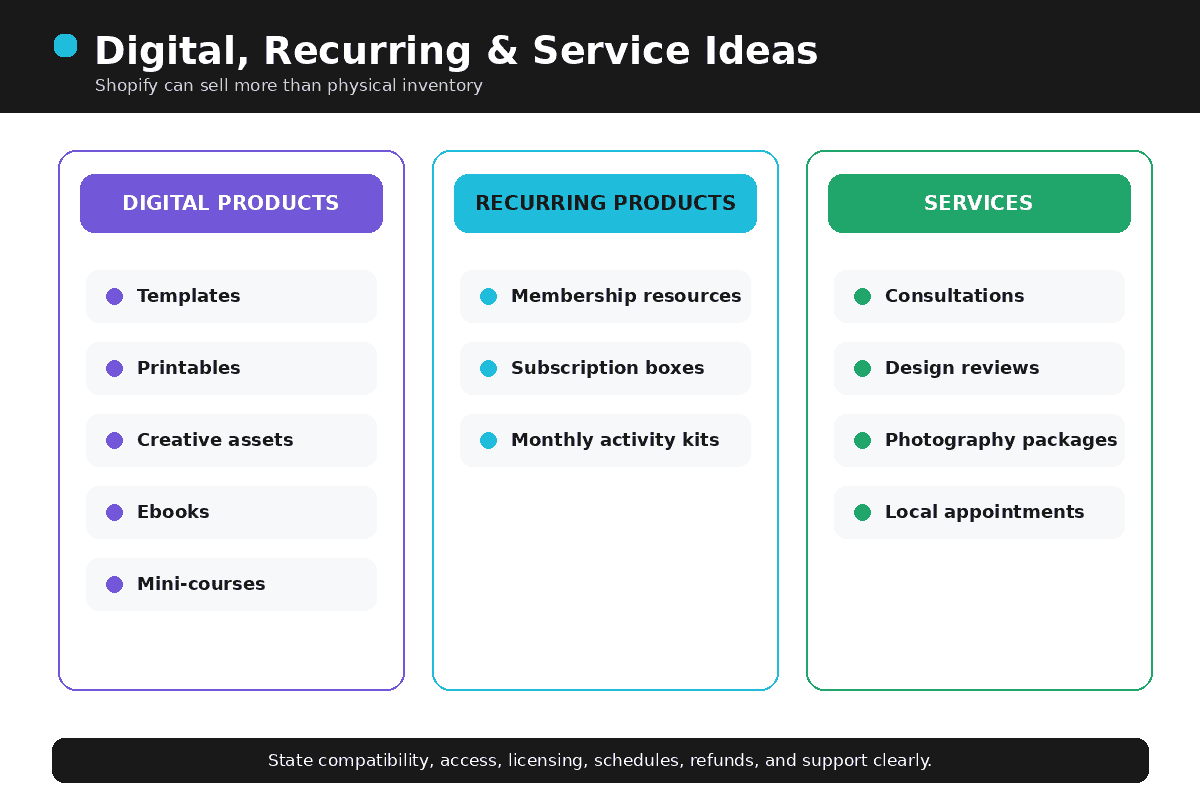
30. Productized Services
Shopify can sell clearly defined services such as consultations, virtual styling, design reviews, photography packages, maintenance sessions, or local appointments. Productize the scope: what the buyer receives, how long it takes, what they must provide, how scheduling works, and what counts as a revision. Confirm licensing, insurance, tax, privacy, cancellation, and professional requirements that apply to the service.
Which Product Model Should You Choose?
| Model | Useful When | Main Risk |
|---|---|---|
| Made by you | Your skill or design creates differentiation | Labor and capacity limit growth |
| Wholesale inventory | You want control over stock, packaging, and shipping | Cash is tied up before products sell |
| Dropshipping | You want to test products without holding bulk inventory | Less control over quality and delivery |
| Print on demand | Your original designs are central to the product | Unit costs and print consistency |
| Digital products | You can package useful knowledge or assets | Piracy, compatibility, and support |
| Services | Your expertise or time is the offer | Capacity, scheduling, and scope creep |
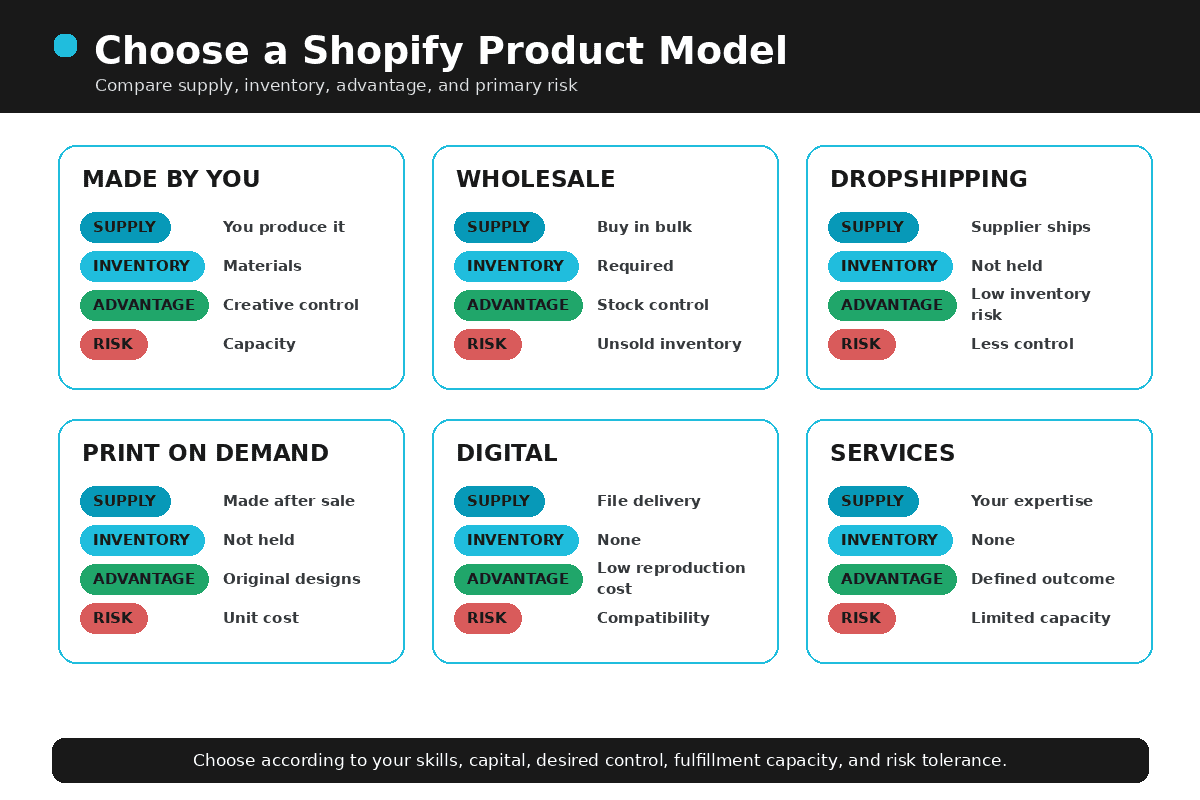
If you want to test supplier products without buying bulk stock, read the Shopify dropshipping guide. It explains suppliers, samples, margins, shipping, cash flow, and customer responsibility.
How to Validate a Shopify Product Idea
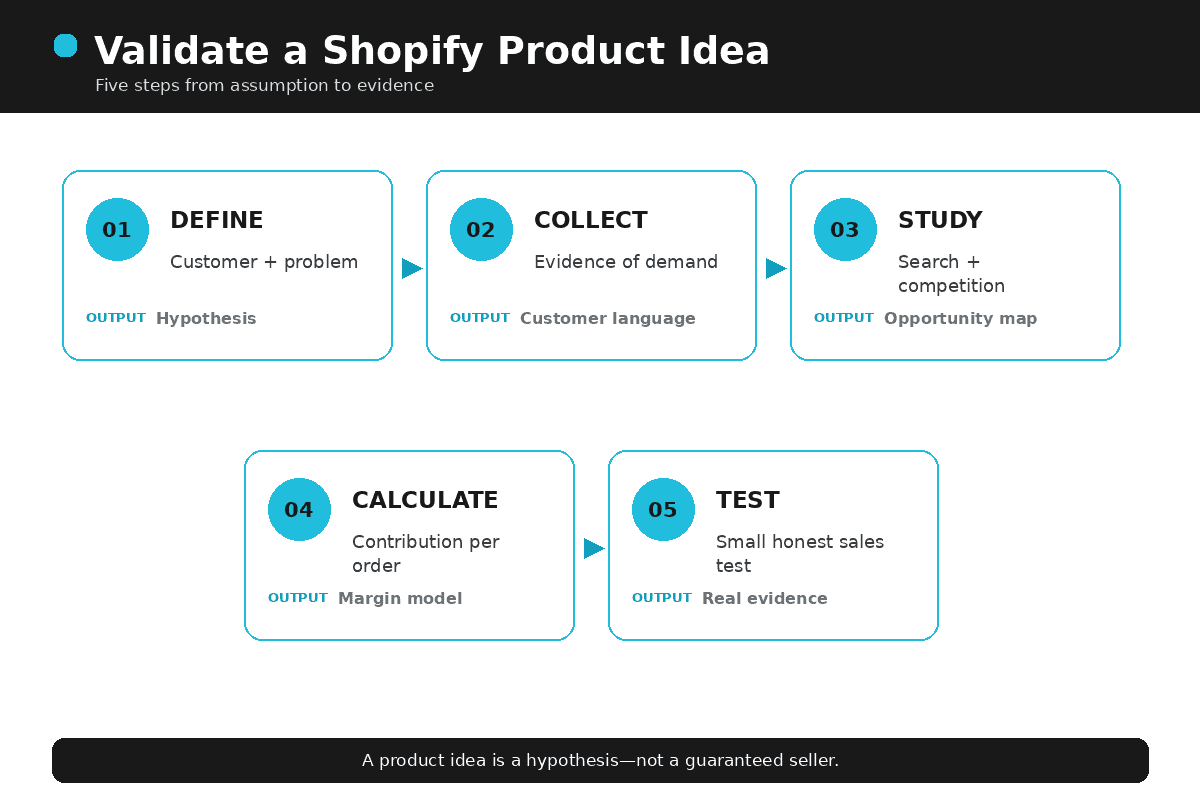
1. Write a One-Sentence Customer Hypothesis
Use this structure: “I help [specific customer] achieve [desired result] with [product] because [meaningful difference].” If the sentence can describe hundreds of unrelated stores, narrow it further.
2. Collect Evidence of the Problem
Interview potential customers, read support questions and reviews, study relevant communities, and note the words people use. Separate compliments from buying intent. Ask what they currently use, what frustrates them, what they have already paid for, and what would prevent a purchase.
3. Study Search Demand and Competition
Use search suggestions, Google Trends, keyword tools, marketplaces, social platforms, and competitor stores to understand demand. A crowded category is not automatically bad, and a product with no competition is not automatically good. Look for a customer or use case that competitors serve poorly. The Shopify SEO guide for beginners explains how to map searches to home, collection, product, and article pages.
4. Calculate Contribution Per Order
Do not confuse markup, gross margin, contribution, and final profit. Start with a conservative order-level calculation:
Contribution per order = selling price − product cost − inbound freight − packaging − outbound shipping − payment expenses − variable app costs − discounts − return allowance − marketing cost
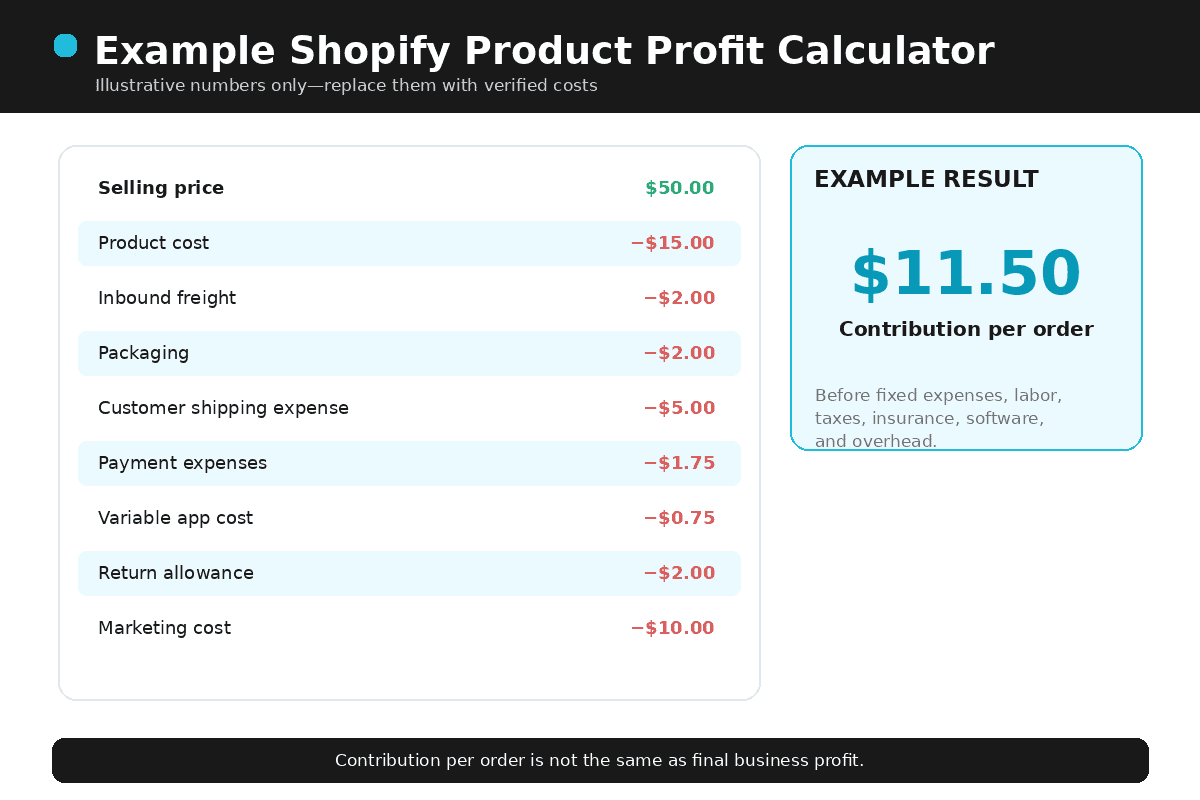
Then account for fixed expenses, labor, taxes, insurance, software, professional services, and overhead. Use my Shopify pricing guide to identify platform and operating costs that beginners frequently overlook.
5. Run the Smallest Honest Test
A test might be customer interviews, a prototype, samples, a local market, a limited preorder with clear timing, a waitlist, or a small first batch. Do not accept payment for a product you cannot lawfully and reliably deliver. Define the evidence you need before running the test: qualified signups, completed purchases, acceptable acquisition cost, low return intent, or repeat interest.
How Many Products Should a Beginner Sell?
There is no required number. A beginner is usually better served by one hero product or a small, related collection that can be sampled, photographed, described, priced, and supported properly. A catalog of hundreds of imported items can hide weak product decisions and create inventory, navigation, SEO, and customer-service problems.
Look at the merchandising and navigation lessons in these successful Shopify store examples. Strong stores make the customer, product category, value, and next action easy to understand.
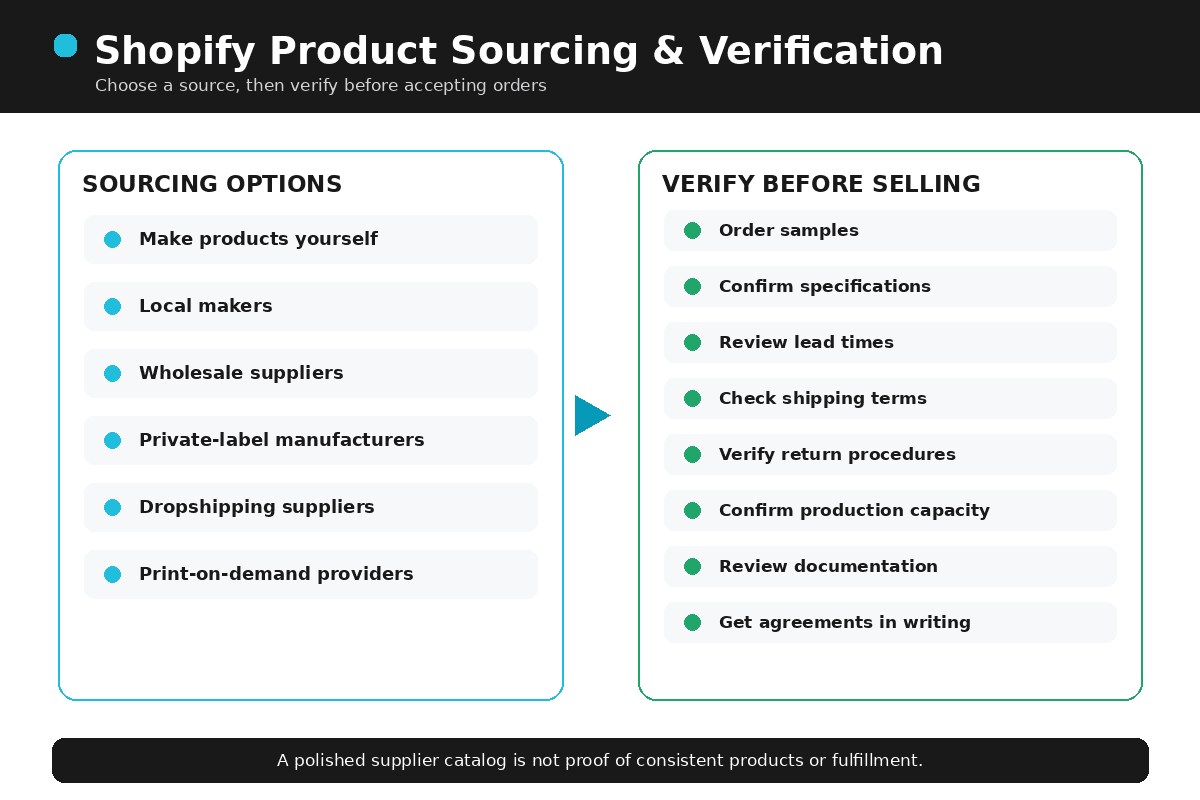
Where to Source Products
- Make them yourself: greatest creative control, but labor and capacity matter.
- Local makers or manufacturers: closer communication and a regional story, subject to capacity and wholesale terms.
- Domestic or international wholesalers: established catalogs, minimum orders, and inventory risk.
- Private-label manufacturers: more control over branding and specifications, usually with larger commitments.
- Dropshipping suppliers: no bulk inventory purchase, but reduced fulfillment control.
- Print-on-demand providers: made-to-order customized products with sample and rights considerations.
Request samples, business documentation, references, product specifications, testing records when relevant, lead times, capacity, shipping terms, return procedures, insurance information, and a written agreement. A professional-looking catalog is not proof that the supplier can deliver consistently.
Products Beginners Should Approach Carefully
Some categories can be legitimate businesses but add safety, regulatory, insurance, shipping, and claim risk. Get qualified advice before selling:
- Food, beverages, supplements, and ingestible products
- Cosmetics and products making skin or health claims
- Children’s products, toys, sleep products, and car-safety items
- Medical, therapeutic, protective, or performance claims
- Electronics, batteries, chargers, and heated products
- Weapons, controlled goods, alcohol, nicotine, or age-restricted items
- Products using trademarks, characters, photographs, music, or designs you do not own or license
- Items with unclear origin, certification, ingredient, or safety documentation
The FTC explains that advertising claims need appropriate support, particularly for health-related products. Its advertising and marketing guidance is a useful starting point, but it does not replace product-specific legal advice.
How to Build the Store Around the Product
- Choose the customer, problem, product, and differentiation.
- Verify the supplier or production process and order samples.
- Calculate pricing and cash-flow needs.
- Create original photographs, demonstrations, descriptions, and specifications.
- Build a focused homepage, collection structure, product pages, policies, and support process.
- Configure payments, taxes, shipping, notifications, analytics, and inventory.
- Test desktop, mobile, checkout, fulfillment, email, cancellation, return, and refund workflows.
- Launch to a qualified audience and measure the complete funnel.
The complete Shopify store setup tutorial walks through the platform steps. If you want a faster visual starting point, my Shopify AI Store Builder review explains what the AI tool creates and which product, content, settings, and testing work still remains.
Common Product-Selection Mistakes
- Choosing a product only because it is trending
- Copying competitor products, photographs, or descriptions
- Ignoring shipping dimensions, damage, returns, or seasonality
- Calculating profit without marketing and customer-service costs
- Launching too many unrelated products
- Trusting supplier claims without samples or documentation
- Using copyrighted or trademarked material without permission
- Making environmental, origin, health, or performance claims without support
Review the complete Shopify mistakes guide before launch. It covers product information, design, apps, SEO, checkout, shipping, mobile usability, marketing, and maintenance.
How to Launch and Get the First Customers
Do not wait until launch day to identify the audience. Build a small list of qualified people, communities, partners, creators, search topics, and content opportunities while developing the product. Create demonstrations that answer real objections instead of filling social feeds with generic announcements.
Use the Shopify store launch checklist before accepting orders, then follow the first Shopify sale plan for outreach, audience building, launch activities, and funnel measurement.
Should You Sell on Shopify, Etsy, WooCommerce, or WordPress?
Shopify is a hosted commerce platform, Etsy is a marketplace with its own audience and product rules, WooCommerce adds ecommerce to a self-hosted WordPress website, and WordPress itself is a broader publishing and website platform. The best choice depends on what you sell, how customers find you, the control you need, and the technical work you can manage.
Use these focused comparisons before choosing:
- Shopify vs. Etsy for an independent store versus a marketplace.
- Shopify vs. WooCommerce for two ecommerce systems.
- Shopify vs. WordPress for commerce-first versus content-first website platforms.
What to Sell on Shopify FAQs
What is the easiest product to sell on Shopify?
No product is automatically easy. Digital downloads and print-on-demand products can reduce inventory and shipping work, while simple physical products may be easier for customers to understand. The best beginner product is one you can validate, create or source reliably, explain clearly, support responsibly, and sell with enough margin.
What products are most profitable on Shopify?
Profit depends on your price, costs, return rate, marketing efficiency, repeat purchases, and overhead—not the category name alone. Digital products can have low reproduction costs, while specialty physical products can support higher perceived value. Calculate the economics for your exact offer instead of relying on a generic margin claim.
Can I sell products I do not make?
Yes. Depending on your agreements and applicable rules, you can buy wholesale inventory, use a dropshipping supplier, partner with makers, use print on demand, or develop private-label products. Verify resale rights, authenticity, product documentation, intellectual property, and fulfillment before listing an item.
Can I sell digital products on Shopify?
Yes. Shopify can sell digital downloads, templates, guides, creative assets, courses, and other nonphysical products through a suitable delivery setup. Clearly disclose file types, compatibility, access, license terms, refund conditions, and support.
How many products should I launch with?
Launch with the smallest catalog that delivers a coherent customer offer. That might be one hero product with variants, a focused collection, or a compatible bundle. Add products when customer data shows a real need.
Can I start before paying for a full Shopify plan?
You can use Shopify’s available trial or promotion to explore the platform and begin building, but terms can change. Read my Shopify free trial guide and verify the current offer before signing up.
Do I need inventory to start?
Not always. Digital products, services, dropshipping, print on demand, made-to-order goods, and carefully managed preorders can reduce upfront inventory. Each model has different production, cash-flow, delivery, and customer-service risks.
How do I know whether an idea will sell?
You cannot know with certainty before launch. Reduce uncertainty by documenting customer problems, studying demand and competition, testing samples, calculating margins, and running a small honest sales test. Treat early results as evidence to improve the offer.
Final Verdict
The best thing to sell on Shopify is not simply the category receiving the most attention today. It is a product that serves a reachable customer, solves a meaningful problem or desire, can be differentiated honestly, and produces workable economics after every cost.
Choose three ideas from this list, score them against customer need, demand, competition, margin, fulfillment, content potential, and risk, and then validate the strongest one with real people and a small test. Build a focused store only after the evidence supports the decision.
When you have a product hypothesis and a realistic validation plan, create your Shopify store and test the complete customer experience. Keep the store protected until the product pages, policies, checkout, fulfillment, notifications, returns, and support process work from beginning to end.