Posts

Bluehost Data Center Locations and Server Locations (2026)

If you are trying to find the Bluehost data center locations or want to know where your Bluehost website is hosted, the answer depends on the type of Bluehost hosting you use.

Bluehost now offers different data center choices across products such as Cloud Hosting, Agency Hosting, and Self-Managed VPS. Some hosting products let you select a location when the website or server is created, while others show the assigned data center inside your Bluehost account.

If you are considering Bluehost, you can view the current Bluehost hosting plans and discount here.

Bluehost Data Center & Server Locations (2026!) ๐Ÿ”ฅ

Where Are Bluehostโ€™s Data Centers Located?

Bluehost operates hosting infrastructure across multiple geographic regions, but there is not one universal list of locations that applies to every Bluehost hosting product.

The locations you can use depend on whether you are purchasing standard web hosting, Cloud Hosting, Agency Hosting, VPS hosting, or another Bluehost service.

For Bluehost Cloud and Agency Hosting, Bluehost currently documents these primary data center choices:

  • Los Angeles, California, United States
  • Dallas, Texas, United States
  • Ashburn, Virginia, United States
  • Amsterdam, Netherlands
Map showing Bluehost data center locations in Los Angeles, Dallas, Ashburn, and Amsterdam

Bluehost Cloud and Agency Hosting currently offer primary data center choices in Los Angeles, Dallas, Ashburn, and Amsterdam.

Your selected location acts as the primary data center.

Bluehost also uses replication, failover systems, and CDN technology on supported cloud infrastructure, so selecting one primary data center does not necessarily mean every request to your website must always be served directly from that one physical location.

If you are still deciding whether Bluehost fits your website, read my guide explaining what Bluehost is and what Bluehost is used for.

Bluehost Data Center Locations by Hosting Type

The biggest change to understand is that Bluehostโ€™s server locations are now more product-specific.
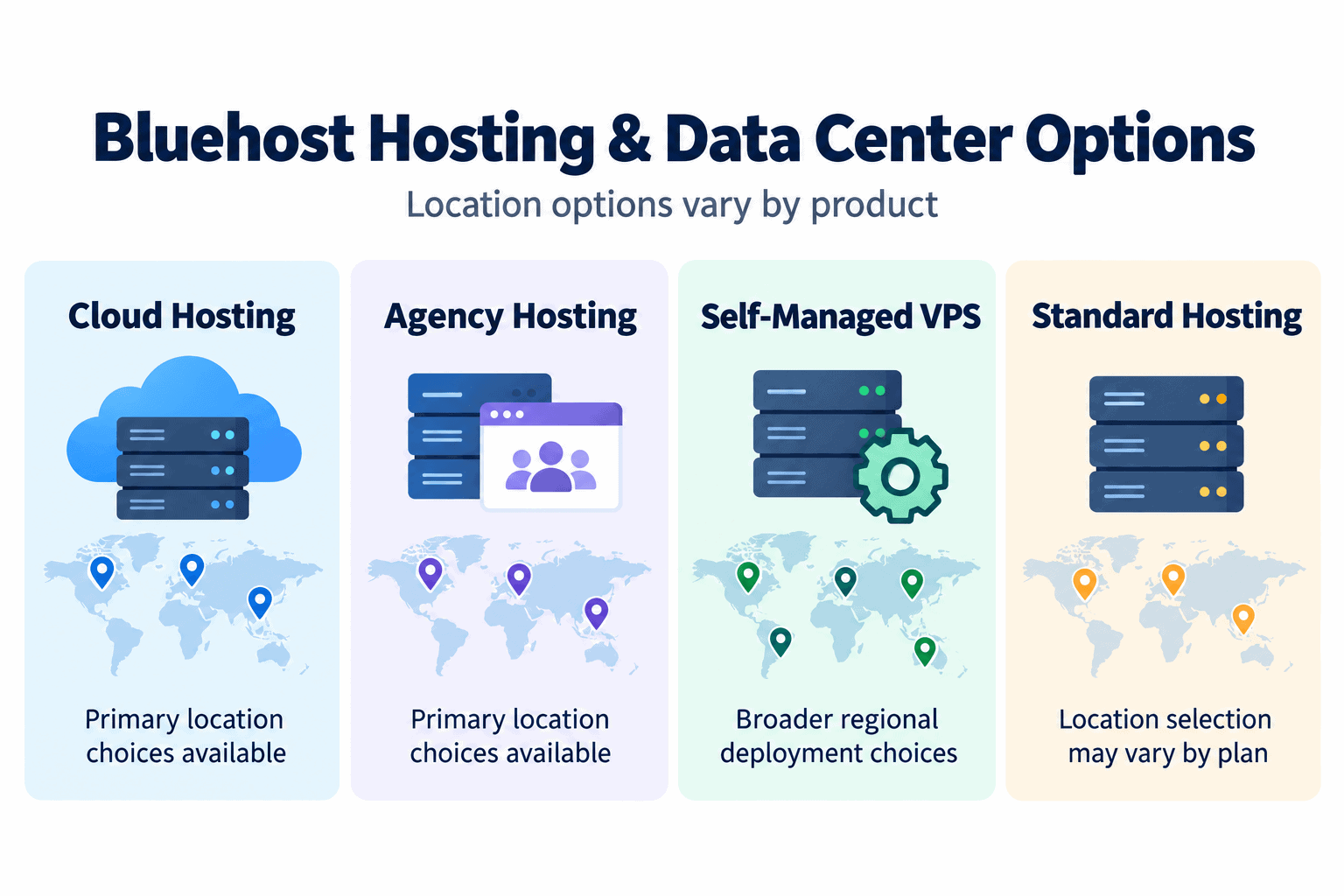
Bluehost hosting products with different data center location options

Bluehost data center availability varies depending on the hosting product you choose.

Bluehost Cloud and Agency Hosting Data Centers

Bluehost currently allows Cloud and Agency Hosting customers to choose from four primary locations:

Region Primary Data Center
Western United States Los Angeles, California
Central United States Dallas, Texas
Eastern United States Ashburn, Virginia
Europe Amsterdam, Netherlands
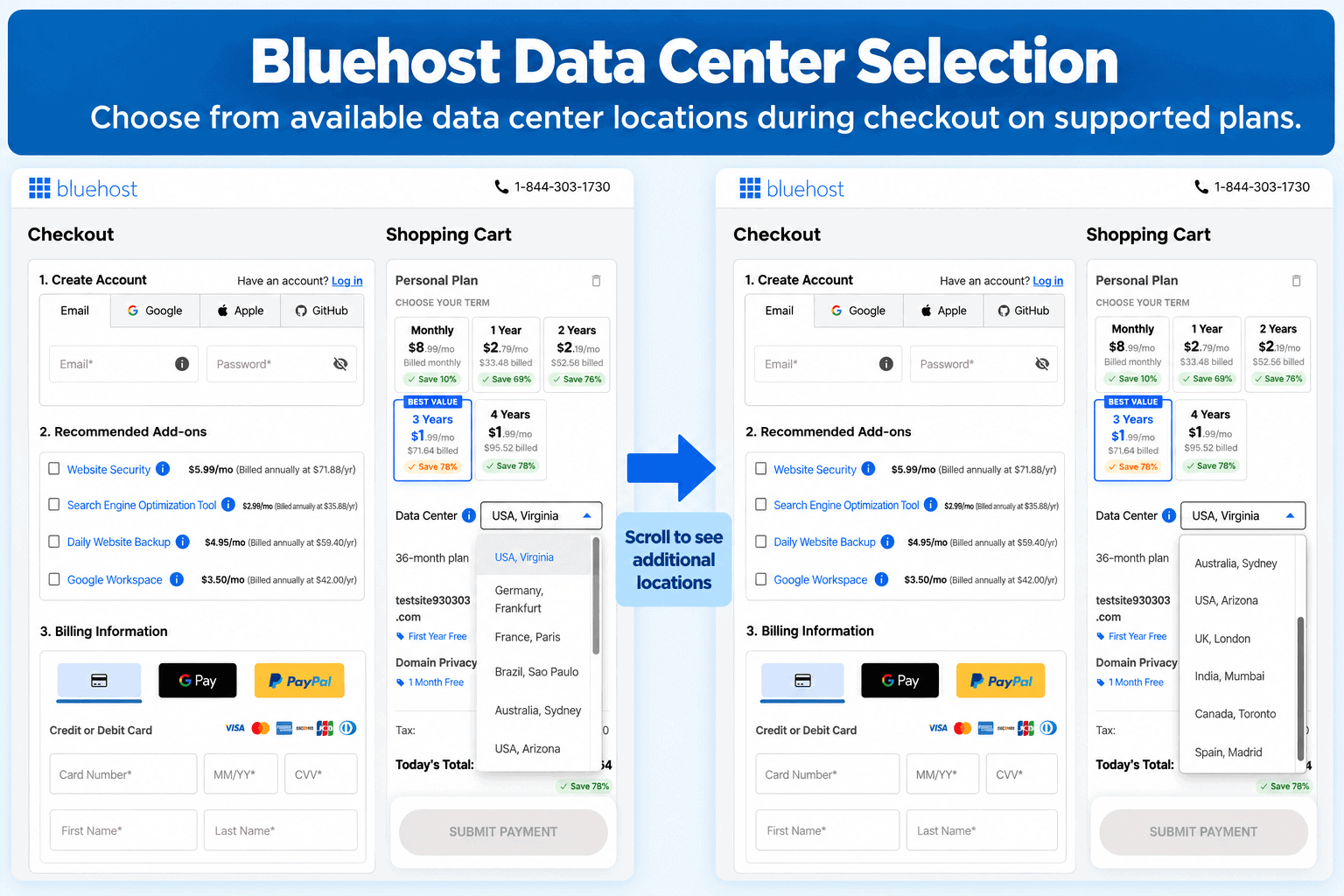
Bluehost setup screen showing available data center location choices

Supported Bluehost plans let you choose a primary data center during setup.

Bluehost recommends choosing the location closest to the majority of your visitors when possible.

If you are comparing plans before signing up, see my Bluehost pricing and plans guide and my guide explaining which Bluehost plan is best.

Bluehost Self-Managed VPS Locations

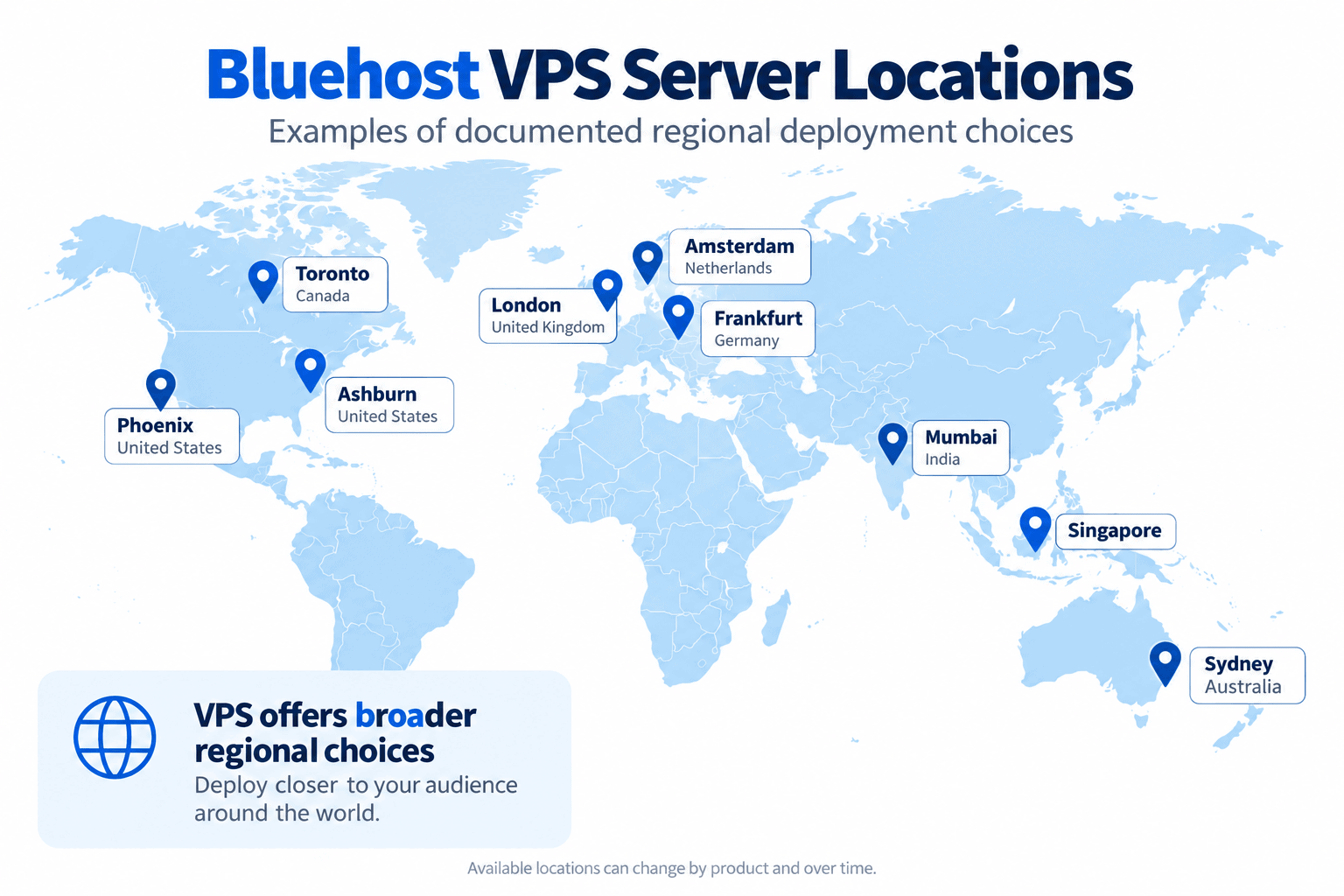
Bluehost Self-Managed VPS gives customers more regional deployment choices.

Bluehost currently documents VPS deployment options across the United States, Canada, Europe, India, Singapore, and Australia. Available locations can change as Bluehost expands its infrastructure, so the location selector shown when you configure the VPS is the best place to confirm the choices currently available to your account.

Recent documented locations include areas such as:

  • Ashburn, United States
  • Phoenix, United States
  • Toronto, Canada
  • Amsterdam, Netherlands
  • Frankfurt, Germany
  • London, United Kingdom
  • Mumbai, India
  • Singapore
  • Sydney, Australia
Bluehost VPS server locations across North America, Europe, Asia, and Australia

Bluehost Self-Managed VPS offers a broader selection of deployment regions than some other Bluehost hosting products.

Because Bluehost has continued expanding its VPS infrastructure, you may see additional supported regions depending on the product and date you purchase.

If you are looking at Bluehost from outside the United States, you may also find my Bluehost Australia review, Bluehost Canada review, Bluehost India review, and guide to using Bluehost in the UK useful.

Which Bluehost Data Center Should You Choose?

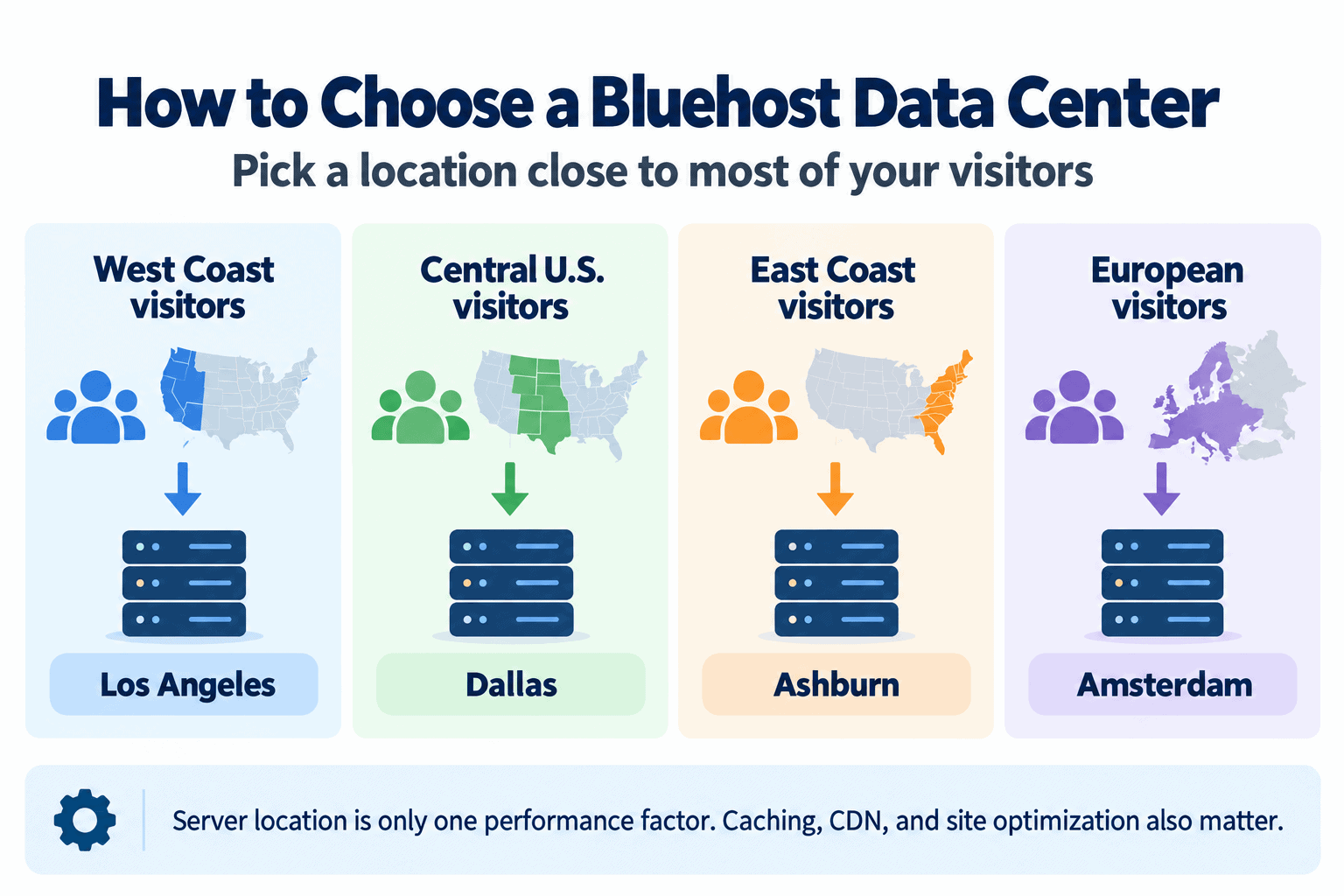
For most websites, choose a data center that is geographically close to the largest portion of your audience.

For example:

  • If most visitors are on the U.S. West Coast, Los Angeles may be a logical Cloud or Agency Hosting location.
  • If most visitors are in the central United States, Dallas may make sense.
  • If most visitors are on the East Coast, Ashburn may be preferable.
  • If most visitors are in Europe, Amsterdam can reduce the distance between your origin server and your primary audience.
Guide for choosing a Bluehost data center based on where website visitors are located

Choose a Bluehost data center close to the largest portion of your website audience when possible.

The closest data center is not the only factor that affects website speed.

Your hosting plan, website optimization, WordPress configuration, caching, CDN, plugins, image sizes, and the amount of server resources available can all affect performance.

If you are building your first website, my Bluehost for beginners review explains what first-time users should expect.

Does Your Bluehost Data Center Affect Website Speed?

Yes. Physical distance between the visitor and the websiteโ€™s origin server can affect latency.

In general, reducing that distance can reduce the amount of time required for requests to travel between the visitor and the server.

However, modern hosting platforms also use caching and content delivery networks to reduce the effect of geographical distance.

For that reason, you should think of the Bluehost data center as the origin location rather than assuming every website asset will always be delivered directly from that facility.

If you plan to create a WordPress site, follow my guide to installing WordPress on Bluehost.

You can also follow my complete Bluehost website-building tutorial or my guide to starting a WordPress blog with Bluehost.

How Bluehost Cloud Hosting Uses Multiple Data Centers

Bluehostโ€™s Cloud and Agency infrastructure does more than place a website in one data center.

Bluehost states that supported websites are replicated across its available infrastructure. The location you choose becomes the primary location, while synchronized copies help provide redundancy and automatic failover.

For example, a site with Dallas as its primary data center can still have replicated infrastructure available in Bluehostโ€™s other supported cloud locations.

If the primary location experiences an infrastructure problem, Bluehost can use its failover architecture to help maintain availability.

This is different from traditional hosting where you might think of one server in one building as the only place your website exists.

Bluehost Data Center vs CDN: What Is the Difference?

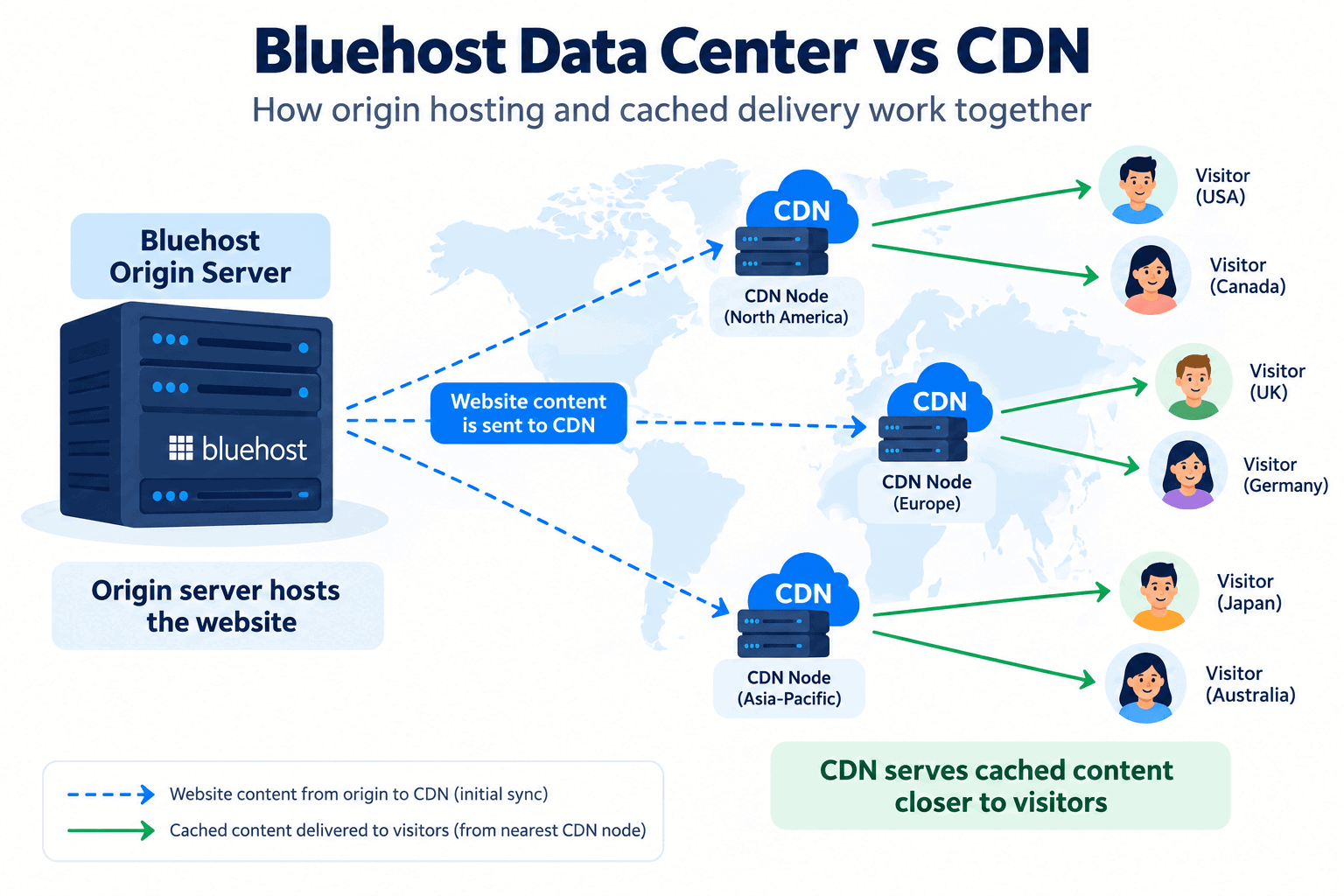
A data center is where the primary hosting infrastructure for your website or server is located.

A content delivery network distributes or caches website content closer to visitors in different geographic areas.

The two work together.
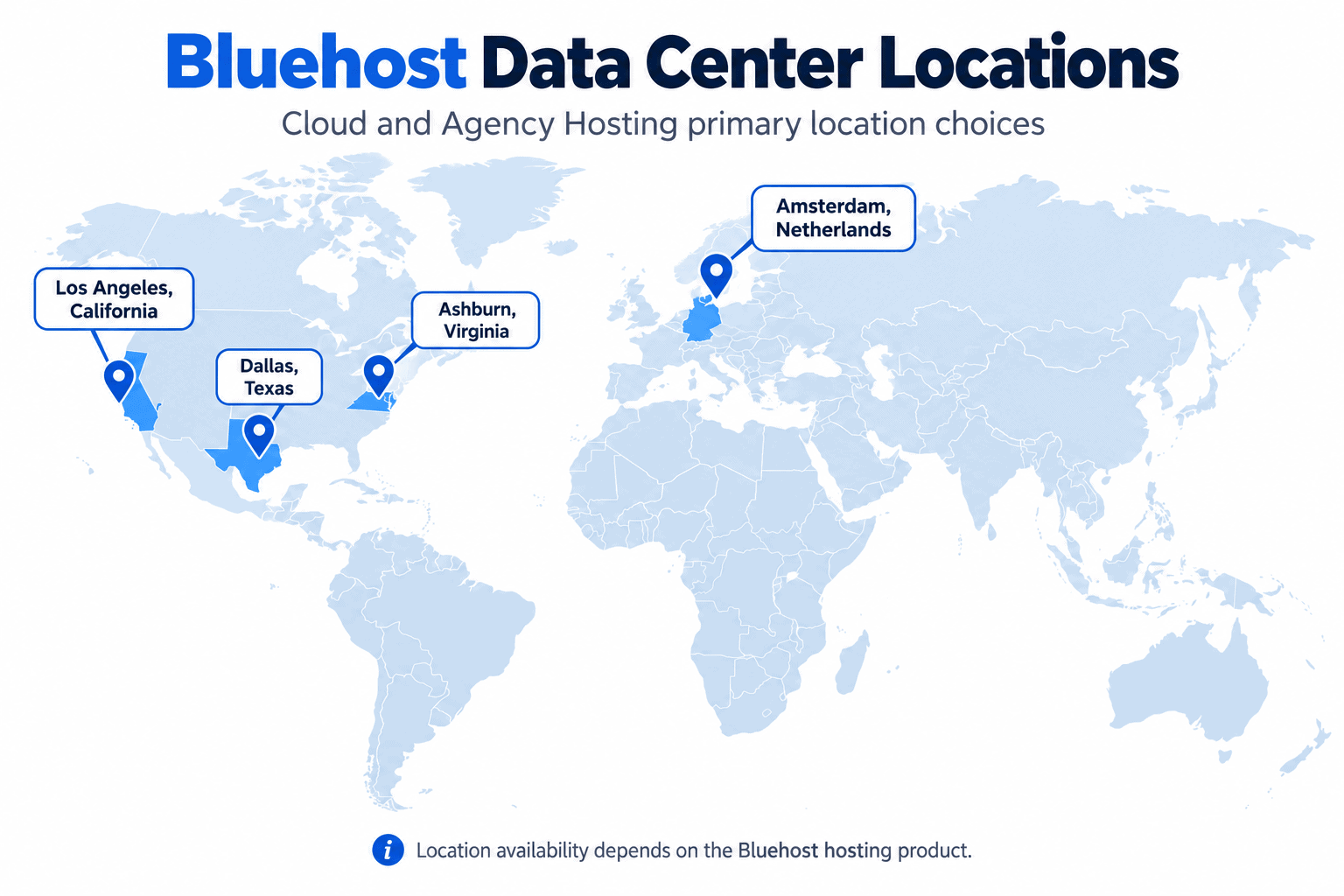
Diagram comparing a Bluehost origin data center with a content delivery network

The origin server hosts the website while a CDN can serve cached content closer to visitors.

Your Bluehost server or primary cloud location handles the origin website, while a CDN can deliver cached content from locations closer to the visitor.

That means someone visiting from another country may receive cached content from a nearby CDN location even when your origin hosting is in the United States or Europe.

How to Find Your Bluehost Data Center

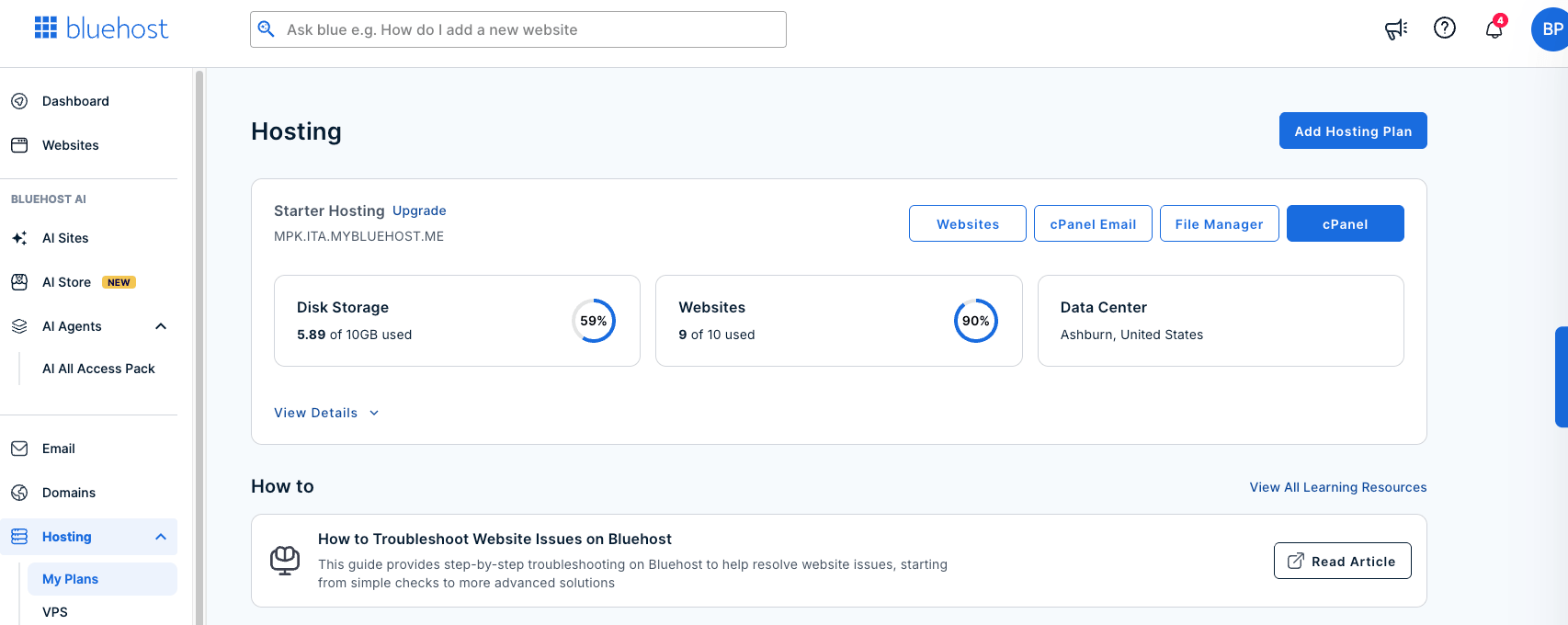
Bluehost now makes it easier to see the data center associated with supported hosting plans.

Log in to your Bluehost account and open the Hosting section.

Your hosting information can include details such as:

  • Hosting plan
  • Website information
  • IP address
  • Server information
  • Data center location
Bluehost hosting dashboard showing server and data center information

Check your Bluehost hosting dashboard to see the server and data center information available for your plan.

For VPS products, Bluehost can also show the serverโ€™s data center location within the VPS details.

This is more reliable than trying to determine your physical server location from an IP address alone.

Can You Choose Your Bluehost Server Location?

It depends on the hosting product.

For products such as Bluehost Cloud, Agency Hosting, and supported VPS plans, Bluehost provides a location selection during site or server creation.

Other products may assign the hosting infrastructure automatically.

Do not assume that every Bluehost plan offers the same location selector.

Check the options displayed for the specific plan before completing your purchase.

If you have not created your Bluehost account yet, see my Bluehost signup tutorial or my walkthrough showing how to buy web hosting from Bluehost.

You can also check the current Bluehost plans and offers here.

Can You Change Your Bluehost Data Center Later?

Whether you can effectively move to another location depends on the Bluehost product.

For Cloud and Agency Hosting, Bluehost documents a process in which a website can effectively be moved to another primary data center by creating a staging site in the desired location and then promoting that environment to production.

For Self-Managed VPS, Bluehost states that the deployment location is selected when the VPS is created and cannot simply be changed after provisioning.

Because these rules vary between products, check the current Bluehost documentation or contact Bluehost support before assuming your location can be changed later.

Do Bluehost Data Centers Matter for WordPress?

Yes, but the data center is only one piece of WordPress performance.

A properly optimized WordPress website can benefit from:

  • A server location close to its main audience
  • Page caching
  • A CDN
  • Optimized images
  • Efficient plugins
  • Updated WordPress software
  • HTTPS

For HTTPS setup, see my Bluehost free SSL certificate tutorial.

If you want to build the site with Elementor, see my guide to using Elementor with Bluehost.

You can also learn how to remove the Bluehost Coming Soon page when you are ready to launch.

Bluehost Data Centers for International Websites

If you serve visitors in several countries, do not focus only on choosing the exact physical location of the origin server.

Choose a suitable primary region and then use caching and CDN technology to serve visitors efficiently across different geographic areas.

Your target audience matters more than your own physical location.

For example, if you live in Europe but most of your customers are in the United States, a U.S. origin location may make more sense than choosing Europe purely because that is where you live.

For location-specific information, see my Bluehost Australia review, Bluehost Canada review, Bluehost India review, guide to Bluehost for UK websites, and Bluehost India vs Bluehost.com comparison.

Is Bluehost Good for Different Types of Websites?

Server location is important, but your website type and resource requirements should also influence the hosting plan you choose.

For more specific use cases, see my guides covering Bluehost for blogging, Bluehost for small businesses, Bluehost for photographers, Bluehost for ecommerce, and Bluehost for beginners.

If you are considering the Choice Plus plan specifically, see my Bluehost Choice Plus plan review.

Connecting a Domain to Your Bluehost Hosting

Your domain name does not have to be registered at Bluehost in order for your website to use Bluehostโ€™s servers.

You can point a domain from another registrar to your Bluehost hosting account.

For step-by-step instructions, see my guides on pointing a Namecheap domain to Bluehost, pointing a GoDaddy domain to Bluehost, adding an addon domain in Bluehost, and getting a free domain name with Bluehost.

Bluehost Hosting Without WordPress

Bluehost is closely associated with WordPress, but WordPress is not the only type of project you may want to host.

See my guide to using Bluehost without WordPress if you are considering another CMS or a custom website.

Developers should also read my Bluehost Node.js hosting guide to understand the hosting requirements for Node.js projects.

Bluehost Pricing, Billing, and Discounts

Data center location should not be your only consideration when choosing Bluehost.

Also compare the billing term, introductory price, renewal price, included features, and the total due at checkout.

For pricing and discounts, see my Bluehost coupon code guide, Bluehost pricing and plans guide, explanation of whether Bluehost charges monthly or all at once, Bluehost free trial guide, and Bluehost money-back guarantee guide.

If you already have an account and need to leave, see my guide to canceling Bluehost and requesting a refund.

I also cover why Bluehost can seem so cheap, why Bluehost can become more expensive, and the Bluehost Black Friday deal.

You can check Bluehostโ€™s current hosting offer here.

Bluehost Payment Methods

If you are ready to purchase hosting, you may also want to confirm how you can pay.

My Bluehost payment methods guide covers the available payment options.

I also have separate guides explaining whether Bluehost accepts debit cards, whether Bluehost accepts PayPal, and whether Bluehost accepts Bitcoin.

Bluehost Package Extras and Add-ons

During signup or while managing your hosting, Bluehost may offer optional products and services.

Before paying for an add-on, determine whether your hosting plan already includes similar functionality or whether you can get the feature elsewhere.

Start with my Bluehost package extras guide.

You can also read my guides covering CodeGuard Basic, Bluehost SEO Tools, domain privacy protection, SiteLock Security, Single Domain SSL, Yoast SEO Premium, Bluehost marketing offers, and Google Workspace with Bluehost.

Who Owns Bluehost?

If you are researching Bluehost as a company in addition to its server infrastructure, see my guide explaining who owns Bluehost.

For a broader explanation of the platform itself, read my guide on why people choose Bluehost.

Bluehost vs Other Hosting Providers

If data center location is one of the factors you are using to compare hosts, you may also want to read my HostArmada vs Bluehost comparison, Bluehost India vs Bluehost.com comparison, and WPX Hosting vs Bluehost comparison.

Frequently Asked Questions

Where are Bluehost servers located?

Bluehost uses multiple hosting locations. The specific locations available depend on your hosting product. Cloud and Agency Hosting currently document primary locations in Los Angeles, Dallas, Ashburn, and Amsterdam, while Bluehost VPS products provide additional regional deployment choices.

Can I choose my Bluehost data center?

On supported Bluehost products, yes. Cloud, Agency, and certain VPS products allow you to choose a location during setup. Other plans may assign the location automatically.

What is the best Bluehost server location?

The best server location is usually the one closest to the majority of your website visitors.

A shorter distance can reduce latency for requests that must reach the origin server.

How do I find my Bluehost server location?

Log in to your Bluehost account and open your hosting information. Supported plans display the associated data center or server information within the Bluehost dashboard.

Does Bluehost have servers outside the United States?

Yes. Bluehost currently documents hosting and VPS infrastructure in multiple regions outside the United States, including locations in Europe, India, Singapore, Australia, and other supported markets depending on the hosting product.

Does Bluehost use a CDN?

Bluehost uses CDN and edge-caching technologies on supported hosting products. A CDN can serve cached website content closer to visitors even when your origin data center is located farther away.

Does server location matter if I use a CDN?

Yes. A CDN reduces the importance of physical distance for cached content, but requests that reach the origin server can still be affected by the distance between the server and the visitor.

Is Bluehost only for WordPress?

No. Bluehost is strongly associated with WordPress hosting, but supported hosting products can also be used for other website systems and development workloads.

See my guide to using Bluehost without WordPress for more information.

Bluehost data center locations and server locations guide

Final Verdict on Bluehost Data Centers

Bluehost now gives customers more location flexibility than a simple one-location hosting model.

The exact Bluehost data center options depend on the hosting product you purchase. Cloud and Agency Hosting currently provide primary location choices in Los Angeles, Dallas, Ashburn, and Amsterdam, while Bluehost Self-Managed VPS provides a broader selection of deployment regions.

For most website owners, the best approach is to choose a primary data center close to the majority of your visitors, then use caching and CDN technology to improve delivery for visitors in other locations.

Before signing up, compare the location choices available for the specific Bluehost plan you want and confirm your billing term, included resources, and total checkout price.

Is Single Domain SSL Bluehost Worth It? Do You Need It?

Website security is paramount in an age where cyber threats and data breaches are on the rise. Ensuring your website’s data is encrypted and secure is crucial for building trust with your site visitors.

But with various SSL options available, it can be confusing to decide which one is the best fit for your website.

In this blog post, we’ll be comparing Bluehost’s free SSL and Single Domain SSL, specifically addressing the question, “What is single domain SSL Bluehost?” to help you make an informed decision.

So buckle up as we dive into the world of SSL certificates!

is-bluehost-single-domain-ssl-worth-it

If you haven’t signed up with Bluehost you can get started by clicking here so you can take advantage of our Bluehost discount getting you up to 73% off + a Bluehost free domain.

Plus, Bluehost offers a 30-day money-back guarantee on their Bluehost web hosting plans.

Related: how to buy hosting from Bluehost

Short Summary

  • Bluehost Single Domain SSL provides encryption, authentication, and identity assurance with a $10,000 warranty protecting your customers.

  • The initial cost of the Single Domain SSL is $3.33 per month which is billed annually costing $39.96 a year and requires annual renewal to maintain security.

  • The renewal cost of the Bluehost single domain SSL is $49.99 per year.

  • The free Let’s Encrypt SSL certificate provided by Bluehost is fine for most sites. The protection is the same. The key difference is with the Bluehost Single Domain SSL Certificate you’ll receive a $10,000 warranty protecting your customers and a Dedicated IP.

Related: is Bluehost Domain Privacy worth it?

What Is Single Domain SSL Bluehost?

The Bluehost Single Domain SSL Certificate is a Bluehost package extra that provides encryption and security for one domain, offering a $10,000 warranty against fraud.

bluehost-single-domain-ssl-package-extra

In simpler terms, it acts as a digital lock for your website, ensuring the data transferred through your site is sent directly to the server without interception.

This gives your customers the confidence that their data is safe when browsing and transacting on your website.

The main advantage of Single Domain SSL Bluehost is its enhanced security compared to a free SSL certificate.

It comes with a $10,000 warranty to protect against any unexpected failures, giving you peace of mind that your website is safe from potential threats.

Related: Is Codeguard Basic Worth It?

Video Tutorial: Is Bluehost Single Domain SSL Worth It? Do You Need It?

Is Bluehost Single Domain SSL Worth It? Do You Need It? (Review)

Bluehost Single Domain SSL Pricing and Renewal

Next, let’s go in-depth on the Bluehost Single Domain SSL pricing and renewal fees so you know what the Premium SSL Certificate costs.

Initial Cost

The Single Domain SSL price is $3.33 per month, totaling $39.96 for the year. The SSL Certificate is charged annually.

bluehost-single-domain-ssl-cost

This cost is separate from the hosting plan and covers only the first year of the SSL certificate.

Related: does Bluehost charge monthly or all at once?

Renewal Fees

The renewal of the Bluehost Single Domain SSL Certificate is billed annually at $49.99.

You can find the renewal pricing in the Bluehost control panel after you’ve signed up with Bluehost under Marketplace > Featured Products > Popular Tab > SSL Certificate.

Validity Period

Bluehost Single Domain SSL is valid for a period of one year, requiring annual renewal.

This means you’ll need to renew the certificate once a year to maintain website security and encryption of your site.

Related: an in-depth look at Bluehost Pricing

Comparing Bluehost’s Free SSL and Single Domain SSL

Now let’s compare the free SSL Certificate with the Single Domain SSL Certificate so you can make an informed decision on whether or not you need the Bluehost single domain SSL over the free Let’s Encrypt SSL Certificate offered by Bluehost.

Security Features

The free Let’s Encrypt SSL certificate provides your site with a secure connection that protects your site from malicious attacks and vulnerabilities. It also protects your site visitors and customers’ information by encrypting confidential data, transactions, and personal information.

Related: how to add addon domain in Bluehost

The Bluehost Single Domain SSL offers the same protection as the free let’s encrypt SSL certificate. The difference is that it comes with identity assurance that includes a $10,000 warranty protecting your customers.

You’ll receive the same security features with a single domain SSL as a let’s encrypt SSL.

Related: Is Sitelock Security Essentials Worth It?

Domain Coverage

The free SSL certificate is a shared SSL certificate across all accounts that provides coverage for all domains and subdomains on the hosting account.

This means that if you have multiple domains or subdomains, you can secure all of them with the free SSL certificate offered by Bluehost.

The Bluehost Single Domain SSL only covers a single domain. If you need to secure multiple domains or subdomains, you’ll have to purchase additional premium SSL plans. The Bluehost single domain SSL is good if you only need to secure one domain without any subdomains.

Related: is Bluehost SEO Tools Start worth it?

Warranty and Liability Protection

The Single Domain SSL certificate comes with a $10,000 warranty in the event of unexpected failure, giving you assurance that your site is secure.

Unfortunately, the free SSL certificate does not provide any warranty, which may leave you at risk in case of unforeseen security breaches.

While the lack of warranty might seem like a significant disadvantage for free SSL certificates, it is important to consider that the encryption method used by both free and paid SSL certificates is identical.

This means that although you do not have the same level of warranty protection, the security features of the free SSL certificate are still effective in protecting your website data.

Related: is Bluehost Yoast SEO Premium worth it?

Dedicated IP

You’ll receive a dedicated IP address with the Bluehost single domain SSL. A dedicated IP address gives your site its own IP address instead of sharing it with others on the same hosting account as you.

With the free Let’s Encrypt SSL Certificate, you won’t receive the added benefit of a Dedicated IP address.

You’ll have a shared IP Address unless you purchase a Bluehost plan that comes with a Dedicated IP or purchase this separately.

Related: is Bluehost Google Workspace Business Starter worth it?

Determining if Bluehost’s Single Domain SSL is Right for You

When deciding if the single domain SSL is right for you, you’ll want to consider a few things based on your needs.

single-domain-ssl

Website Type

When deciding if Bluehost Single Domain SSL is right for you, consider the type of website you have. If your website has a single domain and requires a high level of security, such as an e-commerce site, then Single Domain SSL Bluehost might be a suitable option.

If you have multiple domains or subdomains and you want to take advantage of the $10,000 warranty, it might be more cost-effective to consider a multi-domain SSL certificate as it’ll save you money.

Related: how to build a website with Bluehost

Traffic and Revenue

The applicability of the Bluehost Single Domain SSL is not contingent upon the traffic and revenue of a website, but rather by the level of security required to safeguard sensitive data.

Websites with high traffic and revenue, such as online stores, can benefit from the enhanced security features of Single Domain SSL, which can help boost conversions by increasing customer trust.

On the other hand, websites with low traffic and revenue can still benefit from the heightened security features of Single Domain SSL, as it can help protect sensitive data and transactions from potential threats.

The primary disadvantage of utilizing Single Domain SSL for these types of websites is the cost, as it can quickly accumulate compared to the free SSL certificate.

Trust and Credibility

The Bluehost Single Domain SSL offers trust and credibility to visitors by providing a reliable and secure SSL certificate. When deciding if Single Domain SSL Bluehost is right for you, consider the level of trust and credibility your website requires.

If you need to establish a secure connection and protect sensitive data, such as credit card numbers and personal information, then Single Domain SSL Bluehost might be the right choice for you as it’ll protect your customers with a $10,000 warranty.

Alternatives to Single Domain SSL Bluehost?

Next, let’s go over alternatives to the single domain SSL Certificate offered by Bluehost.

Free Let’s Encrypt SSL

One of the best alternatives to Single Domain SSL Bluehost is the free Let’s Encrypt SSL certificate.

free-lets-encrypt-ssl-certificate

Let’s Encrypt SSL is a free, automated, and open certificate authority that provides digital certificates to enable HTTPS (SSL/TLS) for websites.

It offers Domain Validation (DV) certificates and is compatible with Wildcard Certificates, making it a cost-effective and secure option for most websites.

By opting for Let’s Encrypt SSL, you can still ensure the security of your website without the additional cost of a paid SSL certificate.

The free SSL certificate provides the same level of security as a premium SSL certificate does in terms of encryption and authentication, which is sufficient for most websites, including those that process online payments.

Multi-Domain SSL Certificates

Another alternative to Single Domain SSL Bluehost is multi-domain SSL certificates, also known as Subject Alternative Name (SAN) SSL certificates.

These certificates enable a single certificate to secure multiple domains or subdomains, providing a cost-effective solution for securing multiple domains with a single certificate.

Multi-domain SSL certificates also offer a centralized point of management for all domains, making it easier to monitor the certificate’s expiration date and renewal process.

A great place to get a multi-domain SSL Certificate at a great price and at a discount is Namecheap.

multi-domain-ssl-certificates

Related: how to register a domain name with Namecheap

Is Single Domain SSL Bluehost Worth It?

No, the Bluehost single domain SSL is not worth it for most. The free SSL certificate that comes with Bluehost will work just fine. It provides the same level of encryption and authentication, making it a cost-effective alternative for most websites.

For most websites, the free Let’s Encrypt SSL certificate is sufficient to protect against threats and vulnerabilities, making it the best free alternative.

The primary advantage of Single Domain SSL Bluehost is its warranty, which may be beneficial for websites that process a high volume of transactions and require additional protection against unforeseen security breaches.

In this case, it may be worth paying for an SSL Certificate.

Related: how to install WordPress on Bluehost

Do You Need Single Domain SSL Bluehost?

Ultimately, the decision to invest in Single Domain SSL Bluehost depends on your website’s specific needs and requirements.

Consider the type of website, the amount of traffic and revenue it receives, and the level of trust and credibility it requires before deciding if Single Domain SSL Bluehost is the right choice for your website.

In most cases, the free Let’s Encrypt SSL certificate will provide sufficient security and encryption for your website, making it an ideal alternative to the paid SSL certificate.

Related: how to start a WordPress blog with Bluehost

Final Thoughts

In conclusion, while Single Domain SSL Bluehost offers enhanced security features and a warranty against fraud, it may not be the best choice for every website.

The free Let’s Encrypt SSL certificate provides the same level of encryption and authentication, making it a cost-effective alternative for most websites.

Ultimately, the decision to invest in Single Domain SSL Bluehost depends on your website’s specific needs and requirements.

As you navigate the world of website security, remember that the primary goal is to protect your site visitors and their data.

By carefully considering the type of SSL certificate that best suits your website, you can ensure a secure and trustworthy user experience.

So, whether you choose the free Let’s Encrypt SSL or invest in Single Domain SSL Bluehost, make sure you prioritize your website’s security and your visitors’ trust.

Here are some related Bluehost posts that you might find helpful:

Is Bluehost Sitelock Security Essentials Worth It? Do You Need It?

Two common questions asked regarding Bluehost Sitelock Security Essential are, Is Bluehost Sitelock Security Essentials Worth It? Do I need Bluehost Sitelock Security Essentials?

In this post, we answer these two popular questions asked upon signing up with Bluehost andย go in-depth on what Bluehost Sitelock Security Essentials is so that you have a complete understanding of it.

Also, in this post, we will be giving our honest recommendation so that you can make an informed decision on whether or not the Bluehost Package Extras Sitelock Security add on will be worth having or not.

is-bluehost-sitelock-security-essentials-worth-it

We are excited to provide you with a Bluehost coupon that will get you up to 73% off Bluehost hosting + a Bluehost free domain by clicking here.

Plus, Bluehost offers a 30-day money-back guarantee on their Bluehost web hosting plans. You even get a Bluehost free SSL certificate with your purchase.

What Is Bluehost Sitelock Security Essential?

Bluehost Sitelock Security Essentials is a Bluehost package extra add-on service that protects and provides website security for your entire website through its security monitoring tool.

Bluehost Sitelock Security Essential is a security monitoring tool that scans your website daily to ensure your site hasn’t been hacked and makes sure malware hasn’t been added to your website.

Not only does Sitelock Security Essentials protect your site from malware, malicious attacks, and hackers.

In addition, Sitelock Security Essentials removes malware automatically if any is found on your site so that your website is back to its normal functioning state as quickly as possible.

Sitelock Security Essentials also comes with blacklist monitoring, keeping search engines from blacklisting your site due to malware by keeping your Bluehost website protected.

If a search engine blacklists your site, it could negatively affect your sales and being found online.

bluehost-sitelock-security-essentials-package-extras

Now let’s go over each part of the Sitelock Security add on to have a complete understanding of it, and so you know how Sitelock Security works.

To start, let’s cover the scanning of your website and how that works. The add-on will scan your website daily to ensure no malware has been added to your website.

If malware has been added to your site, it will notify you.

Related: is Bluehost Domain Privacy Protection worth it?

Not only will it notify you if malware has been added to your site, but it will also automatically remove the malware found so that your site stays safe and protected.

Another important feature is it will protect your site from being blacklisted by Google and other search engines.

If malware is on your site, search engines will pick up on this and start showing a red screen to users trying to visit your site.

This will also lead to search engines blacklisting your website, which means your search rankings and being found on the search engines goes away. This is not something you want to happen to your website.

With Sitelock Security Essential, it will keep this from happening as it scans your site daily for malware, notifies you if malware has been found, and will remove the malware keeping your site safe.

Video Tutorial: Is Bluehost Sitelock Security Essential Worth It? Do You Need It?

Is Bluehost Sitelock Security Essentials Worth It? Do You Need It? (Review)

Benefits of Sitelock Security

I now want to cover six benefits of Sitelock Security Essentials. The benefits consist of the following:

  • Daily Malware Scans
  • Malware Removal
  • Blacklist Monitoring
  • Security Dashboard
  • Web Application Firewall and Scanning
  • Verified Security Badge

Now letโ€™s go in-depth on each of the benefits so you can have the question answered is Bluehost Sitelock Security worth it?

Related: is Bluehost Yoast SEO Premium worth it?

Daily Malware Scans

You will receive a daily scan of your website, checking for any malware that has been placed on your site. This will protect you daily if your site is ever hacked and malware is ever added.

You will immediately be notified upon malware being found on your site.

Malware Removal

After a scan has taken place on your site, if malware is detected, not only are you immediately notified, the malware will be removed so that your site remains safe and protected.

Blacklist Monitoring

Blacklist monitoring protects your site from being blacklisted by Google and other search engines. By having Sitelock Security Essentials, your site is scanned daily, and if malware is found, it is removed.

This allows your site to stay safe from being blacklisted, as search engines know when malware is on your site.

Related: Is Bluehost SEO Tools Start Worth It?

Security Dashboard

The security dashboard is an easy place to monitor your siteโ€™s security with an easy-to-use interface.

Web Application Firewall and Scanning

Your site is scanned, and if any outdated vulnerabilities are found with scripts running on your website or via plugins, the vulnerabilities are stopped, and your site remains protected.

If you use WordPress for your site, WordPress plugins can create vulnerabilities for your site if they are not updated regularly.

This is most common with outdated plugins that are abandoned by the developer who developed the plugin.

Official Verified Security Badge

Youโ€™ll get a Sitelock Trust seal which is a verified Sitelock Security badge you can display on your site, providing confidence to your site visitors and customers that your site is protected and secure.

Related: is Bluehost Google Workspace Business Starter worth it?

Bluehost Sitelock Pricing

Now that we have covered what Bluehost Sitelock Security addon is and its benefits, let’s look at the Sitelock pricing and how much it costs with a Bluehost hosting account.

Bluehost Sitelock Security Essentials costs $2.99 per month and is billed annually in the amount of $35.88 at the time of checkout. This will give you the add-on for an entire year.

bluehost-sitelock-security-essentials-cost

After the year, you can choose to renew Sitelock Security if you’d like. The renewal pricing is $5.99 a month and is billed annually in the amount of $71.88.

Related: Does Bluehost charge monthly?

Something to note is you can add Sitelock Security Essentials to your Bluehost hosting account anytime you’d like.

Maybe you aren’t quite sure if you want Sitelock Security now; you can easily add it from the Bluehost dashboard at any time.

An important note about adding it later is that it will cost you more money.

Instead of paying $2.99 per month equaling $35.88, at the time of initially buying Bluehost web hosting, it will cost you $5.99 a month, equaling $71.88.

Related: How much doesย Bluehost cost?

In case you want to purchase Sitelock Security Essentials at a later date, here are the steps needed to add it to your Bluehost web hosting account.

This is what the Bluehost portal looks like once you have signed up with Bluehost.

bluehost-portal-home

Click the Marketplace tab in the left menu.

bluehost-marketplace

Find the add-ons tab from the dropdown and click it.

bluehost-marketplace-addons

It will now showcase all of the different Bluehost add-ons you can add to your Bluehost account.

Related: Is Bluehost Codeguard Basic Worth It?

Find the Sitelock add-on and click it.

bluehost-sitelock-addons

Once you click on the Sitelock add-on, you’ll be on the Bluehost Sitelock dashboard.

bluehost-sitelock-dashboard

You will see over to the right under the checkout section, where you can select the domain you want to purchase Sitelock for. Once you have your domain selected, you’ll see under it Essential – $5.99/mo.

Next, agree to the Sitelock terms and click add to cart so you can purchase Sitelock Security Essential.

bluehost-sitelock-security-add-to-cart

Bluehost Sitelock Plans

Bluehost offers three different Sitelock Security plans that you can choose from with their web hosting service.

When you are signing up with Bluehost, the plan that is offered with the web hosting package is the Sitelock Security Essential plan.

After you have purchased Bluehost hosting, if you go to the Bluehost portal and go to the Sitelock add-ons section and scroll down from the Sitelock add-on page, you will see three different Sitelock Security plans you can choose from.

Bluehost Sitelock Security Essential, Bluehost Sitelock Security Prevent, and Bluehost Sitelock Security Prevent Plus.

bluehost-sitelock-security-pricing-plans

For most, the Sitelock Security Essential plan will do just fine.

All the Bluehost Sitelock plans come with backlist monitoring, file-level scanning, Sitelock Security seal, automatic malware removal, daily malware scans, and unlimited web pages scanned.

The Sitelock Security Prevent plan comes with additional features than the Sitelock Security Essentials plan, such as DDOS protection, automated bot blocking, database scanning, Global CDN/WAF, image optimization, dynamics content caching, and a response time of 6 hours.

The Bluehost Sitelock Security Prevent plan costs $14.99 a month and is billed annually, totaling $179.88.

The Sitelock Security Prevent Plus comes with all the features that the Sitelock Security Prevent plan comes with, plus PCI Compliance Reporting, application patching, a response time of 4 hours, and continuous security scan instead of just one daily one.

The Bluehost Sitelock Security Prevent Plus plan costs $24.99 a month and is billed annually, totaling $299.88.

Bluehost Sitelock Security vs. SSL Certificate

Sitelock Security and SSL Certificates commonly get confused with each other, and these two are in no way the same.

They are both, however, very important for the security of your website. Let’s go in-depth on the differences between the two.

Sitelock Security is a security service that scans your website for malware added by hackers and will remove the malware automatically.

It will also find vulnerabilities in old, outdated WordPress plugins or through scrips, in return protecting your site from malicious attacks and malware being placed on your site.

An SSL Certificate is a digital certificate that encrypts and authenticates data between web browsers and web servers.

When an SSL Certificate is used on a website, your site URL goes from HTTP, which is un-secure, to HTTPS, which is secure.

You will see a lock icon before your website URL.

ssl-certificate-lock-icon

Having an SSL Certificate provides protection so that when users purchase something on a website or enter information in a contact form or sign up for an email newsletter, that data is encrypted and served in a way where hackers or malicious attackers can’t access the information.

Bluehost offers a free Let’s Encrypt SSL Certificate with all their web hosting plans. An SSL Certificate is a must nowadays.

If your site doesn’t have an SSL Certificate, Google will show users a red screen that blocks your website, and most people don’t know how to get around this screen or will feel unsafe visiting your site further.

An SSL Certificate is also a ranking factor when ranking with search engines.

Related: is Bluehost Single Domain SSL worth it?

Bluehost Sitelock Security Alternatives

If you are looking for an alternative to Bluehost Sitelock Security Essential add on, there are three alternatives that I highly recommend in the form of WordPress security plugins.

All three alternatives are free, and you can install and activate whichever security plugin you prefer in the WordPress dashboard. The Sitelock alternatives that I recommend are Sucuri, All In One Security and Firewall, and Wordfence.

All three WordPress security plugins have a premium version that offers more features for security.

The free version of each does a great job of protecting your site from vulnerabilities.

Related: how to install WordPress on Bluehost

Bluehost Cancel Sitelock

If you want to cancel Sitelock Security with Bluehost, all you have to do is reach out to their support team and let them know you want to cancel.

You then won’t have to worry about being charged in the future at the time of renewal for another year of Bluehost Sitelock Security.

Is Bluehost Sitelock Security Worth It?

So is Bluehost Sitelock Security worth it?

Bluehost Sitelock Security Essentials can be worth it as it protects your website daily from malicious attacks and malware.

Not only does it scan your website daily, but it will remove the malware, so you don’t have to worry about your site being blacklisted by search engines.

It can give you peace of mind knowing that your site is well protected. Sitelock Security is an optional package extra add-on and isn’t necessary.

If using WordPress for your website, then one of the alternatives mentioned, such as Sucri, All In One WP Security and Firewall, or Wordfence, might work just fine based on your needs.

Does Bluehost Have Malware Protection

Yes, Bluehost does have malware protection. Bluehost offers malware protection through their package extra add-on known as Bluehost Sitelock Security Essentials.

Does Bluehost Protect Your Website

Yes, Bluehost protects your website from malicious attacks, hackers, and malware; if you get their package extra Sitelock subscription known as Sitelock Security Essentials.

Here’s a helpful guide going over how to build a website with Bluehost.

Here’s a helpful guide on how to start a WordPress blog on Bluehost.

Here are related security posts:

Final Thoughts

We hope you found this article helpful and that it helped you have a complete understanding of not only what Bluehost Sitelock Security Essentials is but if you do need this Bluehost Sitelock Security addon offered by Bluehost for website security.

Let us know in the comments below if you liked this post! We would love to hear from you.

Here are some related Bluehost posts that you might find helpful:

Is Bluehost Domain Privacy Protection Worth It? Do You Need It?

Domain Privacy Protection is a Bluehost package extra offered when you are signing up with Bluehost.

In my opinion, Bluehost Domain Privacy Protection is one of the most important Bluehost package extras offered.

In this post, not only will we cover what Bluehost Domain Privacy Protection is, we will cover three common questions asked when purchasing web hosting services from Bluehost.

The questions are, is Bluehost Domain Privacy Protection worth it? Do you need Bluehost Domain Privacy Protection? How much does Bluehost Domain Privacy cost?

By the end of this post, you will have a clear understanding of Bluehost Domain Privacy Protection so that you can make an informed decision on whether or not it is worth having.

is-bluehost-domain-privacy-protection-worth-it

Related: how to get a free domain name from Bluehost

What Is Bluehost Domain Privacy Protection?

Bluehost Domain Privacy Protection is a package extra add-on offered by Bluehost that protects you so that your personal information isn’t out for the public to get in the whois directory.

Bluehost Domain Privacy protects you from marketers, spammers, scammers, hackers, potential stalkers cyber threats, harassment, and unauthorized access to your website.

bluehost-domain-privacy-protection-package-extras

Now let’s go over how Bluehost Domain Privacy + Protection works so that you will have a clear understanding of what it is.

When you register a new domain name from a domain registrar, your personal information goes out to the whois directory.

Regardless of the hosting company that you choose to register, your domain name with your personal information goes out to the whois directory as domains are regulated by ICANN, known as The Internet Corporation for Assigned Names and Numbers.

ICANN regulates domain names and the ownership of the domains. All domain name providers have to abide by these regulations.

The information that goes to the ICANN directory is your full name, address, phone number, email address, domain name, and internet protocol address, also known as an IP address.

Bluehost Domain Privacy Protection can protect your personal information for you from all of this. By going with privacy protection, Bluehost will protect your private information from the whois database so that you don’t have to worry about personally sensitive data getting into the wrong hands.

Instead of the ICANN directory showing your personal contact information, it will show Bluehost’s generic contact information for anyone who purchases the domain name Privacy package extra with Bluehost.

Here’s an example.

bluehost-domain-privacy-protection

If someone tries to look up your domain name or get your personal contact information here, it’ll show Bluehost’s generic contact information as shown to the right.

Something to note is you still own your domain name if you choose to protect your personal contact information with private protection. It just protects your personal data from going out to the public on the whois directory where your personal domain registration information is displayed.

Video Tutorial: Is Bluehost Domain Privacy Worth It? Do You Need It?

Is Bluehost Domain Privacy Protection Worth it? Do You Need It? (Review)

Benefits of Domain Privacy Protection Bluehost

There are many reasons why you do need to have Bluehost Domain Privacy Protection.

Here are the benefits of choosing Bluehost Domain Privacy Protection.

  • Prevention of personally sensitive information being public on the whois database
  • Prevention of unwanted phone calls
  • Prevention of unwanted postal mail to your address
  • Prevention of spam and junk emails
  • Prevention of personal data being sold
  • Prevention of identity theft
  • Prevention of competitors learning more about you
  • Prevention of fraudulent domain transfers
  • Reduces access to hackers getting into your site and placing malware
  • Up-to-the-minute notifications on your phone for important domain changes
  • Malware scan detection and removal with malware scanner

Now let’s go in-depth about each of these benefits.

Related: is Bluehost Codeguard Basic worth it?

Personal Information Protected

Your personal contact information will be protected.

Instead of your personal data such as your name, address, email, phone number, domain, and IP address being listed to the public on the whois database, Bluehost’s generic contact information will be shown.

This will stop spammers, scammers, marketers, competitors, and hackers from getting access to sensitive data about you as your information is masked publicly.

Unwanted Phone Calls

It’s common to receive phone calls from marketers trying to sell you their services. You could experience calls from companies that offer SEO, web design, advertising, marketing, and other business-related services.

I’ve experienced this firsthand, and the calls can get overwhelming as so many can come in.

Related: is Bluehost Google Workspace Business Starter worth it?

Unwanted Mail To Address

Companies may decide to send you postal mail to your address to sell you their products and services. Whois privacy protection helps stop this.

Spam and Junk Emails

It’s very common to receive lots of spam and other junk mail and emails. I’ve experienced this firsthand in the past. You can receive lots of unsolicited emails every day. Whois privacy helps stop this.

Personal Data Can’t Be Sold

Your personal information won’t be out to the public on the global whois database protecting you from any data breaches, theft, and your information being sold to others.

Identity Theft

Having your personal information out for anyone to access could lead to your personal information getting into the wrong hands and leading to the theft of your identity.

Related: is Bluehost Sitelock Security Essentials worth it?

Competition Knowing More About You

Competitors could get your contact information and access your personal information to get to know more about you.

Related: is Bluehost Yoast SEO Premium worth it?

Fraudulent Domain Transfers

Someone could try to transfer your desired domain name from your current domain registrar by putting together all your personal information and hacking into an account.

Hackers Placing Malware on Site

Having your personal information displayed along with your IP address out to the public could lead to someone trying to hack into your site and placing malware on your site.

Having malware on your site could even get your site blacklisted from search engines limiting your web presence.

With the domain privacy add-on service, you’ll be protected by receiving malware scanner.

SMS Notifications

With SMS notifications, you can set up and choose to receive SMS alerts via text messages on your phone on specific actions that you want to be notified about regarding your domain name.

For example, attempts to make fraudulent domain transfers, move your domain name to another domain registrar, attempts to purchase your domain name, and attempts to re-register your domain name.

Related: is Bluehost SEO Tools Start worth it?

Malware Scan Detection and Removal

You can set up a malware scanner for your site, which will scan your site every 24 hours and notify you if any malware is detected.

Click here to go to Bluehost and save up to 73% on a web hosting plan with the Bluehost coupon code discount! Plus, Bluehost has a 30-day refund policy on web hosting plans. You even get a Bluehost free Let’s Encrypt SSL Certificate.

How Much Does Bluehost Domain Privacy Cost?

Now that we have covered what Bluehost Domain Privacy Protection is and all the benefits let’s now cover the pricing of Bluehost Domain Privacy.

So how much does Bluehost Domain Privacy cost?

If you go with the Basic plan when signing up with Bluehost, Privacy Protection will cost you $0.99 per month. This Bluehost package extra is billed annually at $11.88.

bluehost-domain-privacy-cost

After a year, you can choose to renew domain protection for your domain.

Related: does Bluehost charge monthly?

Does Bluehost Offer Free Domain Privacy?

Now let’s answer the question, can I get Bluehost free domain privacy? Yes, Bluehost offers free domain privacy protection if you choose either the Bluehostย Choice Plus plan, Online Store, or Pro plan while purchasing web hosting from Bluehost.

You will receive free Domain Privacy Protection with Bluehost for free for as long as you have your domain registered with one of these Bluehost plans.

bluehost-free-domain-privacy-plans

Related: is Bluehost Single Domain SSL worth it?

How Do I Get Domain Privacy On Bluehost?

There are two ways to get Domain Privacy on Bluehost.

The first is when you are signing up with Bluehost, and the second is once you already have a Bluehost account and will be adding the domain privacy feature via the Bluehost dashboard.

When checking out with Bluehost, the first way to make your domain private on Bluehost is by adding Domain Privacy + Protection on the package extras section.

how-do-i-get-domain-privacy-on-bluehost

Now let me walk you through the steps of adding the Domain Privacy feature from the Bluehost portal.

Once logged into Bluehost, you’ll be on the main Bluehost portal page.

Click the Marketplace tab found in the left sidebar menu.

bluehost-marketplace

Next, click the add-ons tab from the dropdown menu that appears.

bluehost-marketplace-addons

Scroll down till you find Domain Privacy Protection and click it.

bluehost-addons-domain-privacy-protection

You’ll now be where you can choose a domain you want to assign Domain Privacy + Protection to.

You will see over to the right under the checkout section, where you can select the desired domain name you want to purchase Privacy Protection for.

Once you have your domain selected, agree to the terms and conditions and click the buy now button to complete your purchase.

bluehost-domain-privacy-check-out

Something to note is if you purchase Privacy + Protection at a later date with Bluehost, Bluehost will pro-rate the cost to go till the end of your domain term.

For example, let’s say you add it 3 months after your Bluehost purchase; Bluehost will charge you the remaining nine months left for your domain.

Once the nine months roll around, you will have the opportunity to renew the Bluehost Domain Privacy + Protection for another year.

Is Bluehost Domain Privacy Protection Worth It?

So Is Bluehost Domain Privacy Protection worth it? Yes, Bluehost Domain Privacy Protection is worth it. Protecting your personal information from marketers, spammers, scammers, competition, hackers, potential stalkers, harassment, and unauthorized access to your website is very important.

By having Privacy Protection with Bluehost, your personal information isn’t displayed publicly on the global whois database. Bluehost’s information will be shown for this protecting you.

Click here to go to Bluehost and save up to 73%!

How Do I Make My Domain Private On Bluehost?

To make your domain private on Bluehost web hosting, you just need to purchase privacy protection from the Bluehost package extras section at the checkout page or purchase it within the Bluehost dashboard under the add-ons section.

FAQ: Can All Domain Extensions Get Privacy Protection?

Not all domain extensions (TLDs) offered today allow you to have domain protection. The reason is each registry and hosting provider sets and has its own set of rules regarding this.

Most of the top-level country code domains do not allow WHOIS protection. For example, country domain codes such as .ca, .uk, and .us do not allow privacy protection for your domain.

This is across the board with all the web hosting companies, and web hosting providers, not just Bluehost.

Ready to build your website with Bluehost? Check out the step-by-step guide.

Want to start a blog? Here’s a guide on how to start a WordPress blog on Bluehost.

Here’s a helpful post going over how to install WordPress on Bluehost.

Final Thoughts

We hope you enjoyed this article on is Bluehost Domain Privacy Protection worth it and that it helped you understand what Domain Privacy Protection Bluehost is and answered the question: Do I really need Bluehost domain privacy protection?

Let us know in the comments below if you liked this post! We would love to hear from you.

Here are some related Bluehost posts that you might find helpful:

Is Bluehost SEO Tools Start Worth It? Do You Need It?

Two common questions asked regardingย Bluehost SEO Tools Startย are, is Bluehost SEO Tools Start worth it? Do I need Bluehost SEO Tools Start?

In this review post, we answer these two popular questions and go in-depth on what Bluehost SEO Tools start is so that you have a complete understanding of what the Bluehost addon known as SEO Tools Start is.

By the end of this Bluehost SEO Tools Start review post, you will have all the information needed so that you can make an informed decision on whether or not the Bluehost addon will be right for you.

is-bluehost-seo-tools-start-worth-it

We are excited to provide you with an exclusive Bluehost discount that will get you up to 73% off hosting + a free Bluehost domain name by clicking here.

Plus, Bluehost has a 30-day refund policy on Bluehost web hosting plans. You even get a Bluehost free SSL Certificate.

What Is Bluehost SEO Tools Start?

Bluehost SEO Tools Startย is a search engine optimization service that helps you reach more people by guiding you through a list of tasks and recommendations, helping you improve your site’s SEO so that you can reach more people interested in what you offer.

Bluehost’s SEO Tools is an addon you can add to your web hosting plan once you have completed signing up for Bluehost web hosting.

bluehost-seo-tools-start

SEO, in the name of the Bluehost addon, stands for search engine optimization.

In short, SEO, also known as search engine optimization, is a process in which you improve the quality and quantity of your web traffic through organic search results in the major search engines.

By optimizing your site for SEO, you can begin increasing your web pages ranking for keywords related to what you offer, in return leading to new website visitors and potential customers.

Related: Is Bluehost Package Extras worth it?

A good way to think of this is, let’s say you offer a service or product. You want to show up high on major search engines for that product or service so that when people type in keywords related to what you offer, you show up.

This, in return, can lead to sales and potential customers as they click through and visit your site.

Bluehost’s SEO Tools helps guide you with things you can do and improve on your website to help increase your rankings so that you can show up higher, leading to more web traffic.

Related: is Bluehost Google Workspace Business Starter worth it?

Video Tutorial: Is Bluehost SEO Tools Start Worth It? Do You Need It? (Review)

Is Bluehost SEO Tools Start Worth It? Do You Need It? (Review)

Benefits of SEO Tools Start

Next, I want to go over the ten benefits of the add-on SEO Tools, along with going over a quick overview of each and going over the tools included.

Detailed Marketing Report

You’ll get an SEO dashboard in which the tool will provide you with a personalized marketing report and analysis, giving you a detailed plan of action so that you can make changes to your site to improve your SEO.

The tool provides you with a detailed analysis and a Bluehost SEO Tools score to better optimize your web pages for a higher ranking.

Related: is Bluehost Yoast SEO Premium Worth It?

Site Search Engine Submissions

The tool will submit your site to search engines automatically. It will submit your site to Google, Bing, and Yahoo.

One thing to keep in mind is for a new site, it will take some time for your site to be found online.

Keep Track Of Site Visitors

This helpful feature will keep track of your site visitors and tell you how much traffic you are getting so you can see how many people visit it along with where they are coming from.

Something to keep in mind is it might take a little bit of time before it will show this information, as you need enough visitors to start showing data for organic traffic with this powerful tool.

Related: Is Bluehost Sitelock Security Essential worth it?

Website Rankings

You can check to see how your site is ranking on search engines like Google, Bing, and Yahoo. This tool will also track keywords and how your ranking is doing compared to your competition.

Keyword Discovery Tool

Keyword discovery tool is a free tool that will provide helpful words you can optimize your site for to help you rank better, leading to more organic traffic.

Choosing the right keywords for your pages and posts is crucial in getting more traffic to your website.

Review of your Website

This feature will review your website by providing a site audit and tell you if there are any technical issues that you should look into fixing for your website.

For example, a long loading time as this can impact your search engine rankings. Another example is a missing SSL Certificate, which makes your website secure. This is also a ranking factor.

Related: is Single Domain SSL Bluehost worth it?

Optimization of Website

This feature will help you in examining your site when it comes to search engine friendliness. It will make sure your site is structured in a way for search engines and make sure your titles, links, and meta-descriptions are in order.

On page SEO is important for your site’s SEO to help you rank better with major search engines.

Content on Website

The addon will analyze your content and will give you recommendations for making your content better to help it rank better.

Writing high-quality content is one of the most important factors for improving your search engine rankings.

By improving you’re on page optimization, you can improve your site’s seo.

Related: how to build a website with Bluehost

Mobile-Responsiveness

Mobile searches are on the rise, and more and more people use their mobile devices to search online, buy products and services, or schedule appointments.

The tool will analyze your site to make sure it is mobile responsive and loading fast enough for mobile devices.

The Popularity of your Website

Your website’s popularity with SEO Tools is determined based on the number of links to your website from other sites.

High-quality backlinks to your site can improve your search engine rankings. The more high-quality backlinks you have, the better it can help you.

Related: Bluehost data centers and server locations

Bluehost SEO Tools Pricing

Now let’s look at the Bluehost pricing of the addon so you know how much does Bluehost SEO Tools cost?

SEO Tools costs $1.99 a month, which comes to $23.88 annually. The addon is billed annually, so you will pay $23.88 and receive SEO Tools for an entire year.

At the end of the year, you will have the option to either renew it or not. The renewal pricing will cost you $5.95 a month, which comes to $71.40 for a year.

Related: Does Bluehost charge monthly or all at once?

Something to keep in mind is you can add SEO Tools to your Bluehost web hosting account at any time you’d like.

For example, let’s say you decide not to go with the SEO Tools add-on now but at a later date, change your mind. You can easily add it to your Bluehost account in the Bluehost portal regardless of the web hosting plan you have.

Something to keep in mind is purchasing the addon at a later date will cost you more than if you sign up for it when firstย buying Bluehost hosting.

It will cost you $5.95 a month instead of $1.99 a month. Over the course of a year, paying for SEO Tools Start at a later date will cost you $71.40. It will end up costing you $47.52 more.

Next, I’ll walk you through the steps in adding SEO Tools from the Bluehost portal if you decide you want it at a later date.

Here’s what the Bluehost portal looks like once you have an account with Bluehost.

bluehost-portal-home

Click the Marketplace tab in the left menu area.

bluehost-marketplace

From the dropdown, find the add-ons tab and click it.

bluehost-marketplace-addons

It will now showcase Bluehost add-ons that you can add to your Bluehost account. Find Bluehost SEO Tools in the list of add-on choices and click it.

bluehost-addons-seo-tools

It will now give you two different plans to choose from. You will see the Bluehost SEO Tools Start plan and the Bluehost SEO Tools Grow plan.

bluehost-seo-tools-pricing-plans

Over to the right, you will see Add Bluehost SEO Tools. Where it says choose a plan, click it, and from the dropdown, you can change it to the Start plan.

add-bluehost-seo-tools-start-plan

Where it says select a domain, you can click this and choose from the dropdown all the domains you have with your Bluehost account in which you want the SEO Tools add-on to be for.

Once you are done, click the buy now button to proceed in purchasing one of the SEO Tools plans.

add-bluehost-seo-tools-select-a-domain

Difference Between The Two SEO Tools Plans

Now let’s cover the difference between the SEO Tools Start package and the Grow package.

For most, the SEO Tools Start package will work just fine.

The Start plan comes with ten target keywords you can track for your search engine rankings. It will provide you with a weekly scan of your ranking’s positioning.

Two competitor reports so you can compare your site to the two competitors that you input. A step-by-step search optimization plan to better improve your site. And a monthly progress report.

The Bluehost SEO Tools Grow plan provides you with twenty keywords to track for your search engine rankings. It will provide you with a daily scan of your ranking’s positioning.

Four competitor reports so you can compare your site to the four competitors that you input. It provides you with a step-by-step plan to better improve your site.

Lastly, a prioritized improvement list helping you improve your search optimization on your site.

Bluehost SEO Tools Start vs. Yoast SEO

Bluehost SEO Tools Startย is a good add on offered when it comes to search engine optimization. It can provide some helpful reports and suggestions to help optimize your site for ranking in search engines.

SEO Tools Start can be helpful to beginners if you aren’t too familiar with the basics when it comes to search engine optimization.

If you will be using WordPress to build your website or blog, there is a free version of Yoast SEO that is extremely helpful in optimizing your website for better rankings.

Related: how to start a WordPress blog on Bluehost

It is one of the most popular SEO plugins. The Yoast SEO plugin is powerful when it comes to ranking and being found online.

It provides you with all the tools you need to get your site set up correctly and to be found online.

It has an SEO analysis on posts and pages you are creating or editing that will give you all the things you should be doing to better rank your site.

It’s extremely powerful.

You can put in a focus keyword that you are targeting to rank for. It will let you know improvements you can make and things you need to change to better optimize the post based on the focus keyword you put in.

You can change the SEO title that will show in search engines along with the meta description. Yoast SEO also sets you up with an XML sitemap that will tell search engines which pages to crawl and index to be found online.

The difference between Bluehost SEO Start and Yoast SEO is Bluehost SEO Tools Start provides you with a report on your rankings with competitors and keywords, along with suggestions to help make your site better. Yoast does not.

Yoast SEO takes care of the more technical aspects of SEO. Yoast doesn’t provide reports like Bluehost’s SEO Tools do. Yoast SEO also doesn’t offer site search engine submission.

Bluehost SEO Tools Alternatives

Free SEO alternatives to SEO Tools are Yoast SEO and RankMath.

Both plugins provide the technical side of SEO and getting your website set up correctly.

The plugins also help guide you on posts and pages that you create with recommendations on content length, interlinking, title, keywords, how many times your focus keyword should be used, and much more.

Yoast SEO or RankMath combined with Google Search Console, formerly known as webmaster tools and Google Analytics, are great free tools that you should be utilizing for your website.

Related: Is Bluehost Domain Privacy Protection worth it?

Is Bluehost SEO Tools Start Worth It?

So, is Bluehost SEO Tools worth it?

Yes, Bluehost SEO Tools Start is worth it if you are new to search optimization and need beginner-friendly guidance on optimizing your site for search engines through a detailed action plan. It can also be worth it if you find the free tools like the marketing report, SEO score, and analysis feature helpful.

If you are familiar with optimizing your website, have some knowledge, or are willing to learn some basics about it, one of the SEO Tools alternatives mentioned in the above section might be a better fit.

Here’s a post on how to install WordPress on Bluehost.

Here are related SEO posts:

Final Thoughts

We hope you found this Bluehost SEO Tools Start review article helpful and that it helped you have a complete understanding of not only what Bluehost SEO Tools Start is, but if you do need Bluehost SEO Tools Start.

Let us know in the comments below if you liked this post! We would love to hear from you.

Here are some related Bluehost posts that you might find helpful:

Is Bluehost Codeguard Basic Worth It? Do You Need It?

Two common questions asked regarding Bluehost Codeguard Basic are, is Bluehost Codeguard Basic worth it? Do I need Bluehost Codeguard Basic?

In this post, we answer these two questions and go in-depth on whatย Bluehost Codeguard Basicย is so that you have a complete understanding of Bluehost Codeguard Basic.

We will also be giving our honest recommendation so that you can make an informed decision on whether or not theย Bluehost Package Extras add-on Codeguard Basic will be worth having or not.

is-bluehost-codeguard-basic-worth-it

We are excited to provide you with a Bluehost discount that will get you up to 73% off Bluehost hosting + a free domain name. All plans come with a Bluehost free SSL Certificate too!

Related: does Bluehost provide a free domain name?

What is Bluehost Codeguard Basic

Bluehost Codeguard Basicย is a Bluehost package extras add-on backup service that automatically backups your website and database, along with providing you with a one-click restore option.

bluehost-codeguard-basic-package-extra

Let’s go in-depth on each part of Codeguard basic so you have a complete understanding of it, and so you know if you need Codeguard Basic.

Let’s start with the backup part ofย Bluehost Codeguard Basic.

The Codeguard Backup service of Codeguard will automatically backup your website and save each version of a backup separately.

This way, you have backups automatically saved from each day, where you can easily access them, download them, or restore your site to a previous version.

Codeguard monitors your site daily and checks for changes so that the most recent update gets backed up. Multiple copies of your website’s backups are created and stored across multiple secure locations.

Related: is Bluehost Yoast SEO Premium Worth It?

Let’s cover what the restore part of the Bluehost Codeguard Basic add-on is.

If something happens for whatever reason and you need to restore your site to a previous version, you can use the one-click restore option within Codeguard. You can choose which backup date you want to restore your site to.

By clicking the one-click restore button, your site will then begin to automatically restore itself to the version of the backup you selected.

The one-click restore can be very convenient as you don’t have to update your site to a backup manually in the back end, involving some tech knowledge.

Related: is Single Domain SSL Bluehost worth it? Do you need it?

Video Tutorial: Is Bluehost Codeguard Basic Worth it? Do You Need It?

Is Bluehost Codeguard Basic Worth It? Do You Need It? (Review)

Benefits of Codeguard Basic

There are four benefits when it comes to the Bluehost Codeguard Basic add-on service. The benefits consist of:

  • Automatic Daily Backups
  • Website Monitoring
  • Redundancy
  • One-Click Restore Option

Now let’s go in-depth on each benefit of the add-on service Bluehost Codeguard Basic.

Automatic Daily Backups

The first benefit is the daily automatic backup feature. Automatic backups will make sure your site gets backed up every day so that if something does ever happen and you need to have your site restored to a previous version, you can do so easily.

You just need to select one of the previous versions of any of the daily backups.

Related: is Bluehost Domain Privacy Protection worth it?

Website Monitoring

The second benefit is website monitoring. You can rest easy knowing that in the background, the Codeguard add-on is monitoring your website every day for changes so that the most up-to-date version of your site gets backed up.

Redundancy

The third benefit is redundancy. Codeguard will save redundant copies of your site’s backup files on multiple servers in different locations so that, if needed, you can quickly restore your site to a previous backup.

Related: is Bluehost Google WorkSpace Business Starter worth it?

One-Click Restore Option

The fourth benefit is the one-click restore option. The one-click restore option included with Codeguard is a huge benefit, in my opinion.

The fact that you can restore your site to a previous backup of your choosing with just a click of a button can save you lots of time. Especially if it means having your site being shown to users across the web accurately.

Whether you make an edit to the site and mess something up, or it starts to show weird after you have done an update, you can rest easy knowing you can use the one-click restore option to get your site corrected to the most recent backup of your choosing.

If your site gets hacked into and malware is placed on your site, the one-click restore option can be a lifesaver as you can restore your site to a previous version to correct it.

Related: Is Bluehost Sitelock Security Essentials worth it?

Without this one-click restore option, you would need to take the backup of your site and manually restore your site in the back-end of your site.

This can get a little techy and might take some learning to do if you aren’t already familiar with doing so.

Click here to go to Bluehost and save up to 73% + a free domain name!

Related: Bluehost refund policy

Bluehost Codeguard Pricing

Now that we have covered what Bluehost Codeguard Basic is and the benefits, let’s discuss the Bluehost pricing on this Bluehost package extra add-on service.

If you choose the Bluehost Basic plan or Bluehost Plus plan whenย signing up with Bluehost web hosting, Codeguard Basic will cost you $2.99 a month.

Related: which Bluehost plan to choose?

This add-on is billed annually, so you’d pay $35.88, and this gives you Codeguard Basic for a year.

bluehost-codeguard-basic-cost

At the end of the year, you have the option to renew it again or not.

If you choose the Bluehost Choice Plus plan, Bluehost Online Store plan or Bluehost Pro plan Codeguard Basic comes free upon signup.

Something to note is the Choice Plus plan comes with Codeguard Basic free for the first year. After the first year, you’ll have to pay for the add-on service.

The Online Store and Pro plan comes with Codeguard Basic free for every year you are on the plan.

A good thing to note is you can add Bluehost Codeguard Basic to your Bluehost hosting package at any time.

Let’s say you sign up with the Basic or Plus plan and decide not to go with Codeguard at the time. If you change your mind later, you can purchase the add-on in the Bluehost portal.

Here’s the Bluehost portal once you have an account with Bluehost.

bluehost-portal-home

Click the Marketplace tab and click it.

bluehost-marketplace

Find the add-ons tab from the dropdown and click it.

bluehost-marketplace-addons

Scroll down till you see Bluehost Codeguard. Click it.

bluehost-addons-codeguard

Next, scroll down to the bottom, and you’ll see where it will list out the features and pricing.

You’ll see four different Codeguard Basic Bluehost plans you can choose from. The Codeguard Basic package, Professional, Premium, and Enterprise plans.

You have the option to purchase Bluehost Codeguard and pay monthly.

You’ll get Bluehost Codeguard Basic for $2.99 a month. You’ll get Bluehost Codeguard Professional for $5.99 a month.

You’ll get Bluehost Codeguard Premium for $9.99 a month. You’ll get Bluehost Codeguard Enterprise for $23.95 a month.

bluehost-codeguard-pricing-plans

You can choose to pay for Bluehost Codeguard yearly. Codeguard Basic Bluehost doesn’t offer monthly payments on any Bluehost hosting plans at this time.

Related: does Bluehost offer monthly payments?

If paying yearly, you’ll get Bluehost Codeguard Basic for $35.88 a year. You’ll get Bluehost Codeguard Professional for $59.95 a year.

You’ll get Bluehost Codeguard Premium for $99.95 a year. You’ll get Bluehost Codeguard Enterprise for $239.95 a year.

bluehost-codeguard-yearly-pricing

Click the button on the one you want to go with to add the Codeguard plan to your Bluehost account.

Now let’s cover the difference between the Codeguard plans the Basic, Professional, Premium, and Enterprise plans.

Codeguard Basic Plan

For most, the Basic plan will work just fine. With the Basic plan, you can backup up to 5 websites, which comes with 1 GB of storage; you are limited to 3 restores a month and daily backup and monitoring.

The Basic Codeguard plan costs $2.99 a month, which comes to $35.88 annually.

Codeguard Professional Plan

The Professional plan will allow you to backup up to 10 websites and comes with 5 GB of storage, daily backup and monitoring, on-demand backups, and unlimited restores.

The Professional plan costs $5.99 a month, which comes to $59.95 annually.

Difference Between Basic Plan vs Professional Plan

There are three differences between the Basic and Professional plans.

The first difference is the Basic plan allows you to backup up to five websites, and the Professional plan allows you to backup up to ten websites.

The second difference is the Basic plan comes with a daily backup, and the Professional plan comes with on-demand backups.

On-demand backups allow you to backup your site yourself when you’d like to.

This could be a good option if you make a change to your site and need it backed up right then, are about to make changes to your site and want a backup in case something goes wrong, or your going to be doing an update to your site and need it to back up the site as the site is minutes before you make the changes.

Related: Is Bluehost SEO Tools Start Worth It?

The third difference between the Basic and Professional plans is the storage. The Basic plan comes with 1 GB of storage, and the Professional plan comes with 5 GB of storage.

In terms of storage, if you have five websites to backup or less, the storage included with the Basic Codeguard plan should do just fine.

If you are backing up six to ten sites, then the Professional plan offering 5 GB of storage should be just fine.

Between the two plans, Basic and Professional, the Basic will be fine for most. If you like the fact that you can create on-demand backups when needed, then you might find the Professional plan an attractive plan to choose.

Next, let’s cover the Premium and Enterprise plans.

Codeguard Premium Plan

The Premium plan comes with everything the Professional plan comes with, such as daily backup and monitoring, on-demand backups, and unlimited restores. It will also backup up to 25 websites, and it offers up to 12 GB of storage.

The Premium plan costs $9.99 a month, which comes to $99.95 annually.

Codeguard Enterprise Plan

The Enterprise plan comes with everything the Professional plan comes with, such as daily backup and monitoring, on-demand backups, and unlimited restores. It will also backup up to 100 websites, and it offers up to 25 GB of storage.

The Enterprise plan costs $23.95 a month, which comes to $239.95 annually.

For most, these two plans are more than you would need.

Bluehost Codguard Free Alternatives

If you are using WordPress to build your site, there are two popular backup plugins I recommend choosing that provide free backups.

The two WordPress backup plugins that are free alternatives to Bluehost’s Codeguard areย UpdraftPlusย andย BackWPup.

Related: how to build a website with Bluehost

The only downside to a free backup plugin is it doesn’t come with a one-click restore option.

If something happens and you need to restore your site, you will have to manually upload your backup in the back end, which can be a little techy.

If you aren’t that techy and don’t want to deal with your site’s back-end and manually upload the backup, then Bluehost Codeguard Basic would be a better and easier option.

Is Bluehost Codeguard Basic Worth It?

So, is Bluehost Codeguard Basic worth it? Yes, Bluehost Codeguard Basic is worth having for most, in my honest opinion.

The reason being is that Bluehost Codeguard basic provides you with daily backups of your site and a one-click restore option allowing you to restore your site to a previous backup with a click of a button.

If something were to ever happen to your site, like an editing mistake that you can’t fix or your site gets hacked into, being able to back up your site to a previous version with a click of a button can save you lots of time and headaches.

Do I Need CodeGuard Basic?

No, you don’t need Codeguard Basic with your Bluehost hosting purchase. But having the backup service can make things easier if you ever need to restore your site to a backup from the past with a click of a button.

How To Get Codeguard Basic Free?

To get Bluehost Codeguard Basic completely free, you just need to purchase Bluehost hosting and choose the Choice Plus, Online Store, or Pro plan.

How Much Does Codeguard Cost?

Codeguard costs $2.99 per month, which is billed annually at $35.88 a year. Codeguard membership without Bluehost web hosting will cost you as low as $5 a month, which is billed annually, costing you $60 for the year.

Want to start a blog? Check out our post on how to start a WordPress blog on Bluehost.

Check out the full tutorial going over how to install WordPress on Bluehost.

Final Thoughts

We hope you found this Bluehost Codeguard Basic article helpful and that it helped you decide if Bluehost Codeguard Basic is worth it and if you do need Bluehost Codeguard.

Let us know in the comments below if you liked this post! We would love to hear from you.

Here are some related Bluehost posts you might find helpful:

Is Bluehost Package Extras Worth It? Do You Need It?

Two common questions asked when signing up with Bluehost are, is Bluehost package extras worth it? Do I need Bluehost package extras?

In this post, we go in-depth on each Bluehost package extra so that you have a complete understanding of what each of the Bluehost package extra add-ons is along with the Bluehost pricing of each.

We also go in-depth on which Bluehost package extra add-ons are good to have, and which ones are unnecessary to choose.

Knowing what each of the Bluehost add-on services is under the Bluehost package extras section can save you money as you don’t want to buy something you don’t need.

is-bluehost-package-extras-worth-it

We are excited to provide you with a Bluehost discount that will get you up to 73% off Bluehost hosting + a free domain name.

You’ll get Bluehost for as low as $2.95 per month.

Plus, you’ll get a Bluehost 30-day money-back guarantee on Bluehost hosting plans along with a free Bluehost SSL Certificate.

Related: how to get a free domain name from Bluehost

Bluehost Package Extras

The Bluehost package extras consist of Domain Privacy + Protection, Codeguard Basic, Yoast SEO Premium, Single Domain SSL, Google Workspace Business Starter, and Sitelock Security Essentials.

bluehost-package-extras

Bluehost SEO Tools Start and Microsoft 365 Mailbox was once offered at checkout under the Bluehost package extras section. They are now offered once you sign up with a Bluehost hosting package in the Bluehost dashboard under Marketplace and Bluehost add-ons.

bluehost-marketplace-addons

Related: how to buy hosting from Bluehost

Now the big question is, which of these Bluehost package extra add-ons do you really need?

Let’s now go in-depth on each Bluehost package extras, so you know what each is and if you need it.

Click here to go to Bluehost andย save up to 73% + a free domain name!ย 

Related: Bluehost marketing offers?

Video Tutorial: Is Bluehost Package Extras Worth It? Do I Need It?

Is Bluehost Package Extras Worth It? ๐Ÿ”ฅ Do You Need It? Updated Review!

Domain Privacy + Protection

Bluehost Domain Privacy Protection is an add-on that keeps your personal information private and safe from the public.

When you register a domain name with Bluehost or any company that offers domain names, your personal information such as your contact name, phone number, address, and email address is added to a public database that anyone can access.

The public database is known as the WHOIS Database. All domain names that are registered are added to the WHOIS Database as it is regulated. Your personal information will be safe and private by selecting the Bluehost package extra Domain Privacy + Protection.

Instead of your personal information going out to the WHOIS Database, Bluehost will include their default contact information they use for this. This will protect you from people getting your personal information and protecting you from spammers and telemarketers.

bluehost-domain-privacy-protection

It is very common to get lots of spam and telemarketing emails and calls after registering a new domain name. Companies will pull the public information listed in the WHOIS Database to sell you their product or service.

I’ve experienced this firsthand, and it is overwhelming and doesn’t stop.

Pricing

The pricing of Domain Privacy + Protection is $0.99 per month which is billed annually at $11.88 a year.

Related: does Bluehost charge monthly or all at once?

My Recommendation: I highly recommend choosing the Domain Privacy + Protection package extra add-on. I use this with every domain name that I purchase. It will keep your personal information safe and protected. Bluehost’s default contact information will be shown instead.

Codeguard Basic

codeguard-logo

Codeguard basic is a Bluehost package extra add-on that automatically offers website backups, and a one-click website restore option that will restore your site to a previous backup of your choosing with just a click of a button.

The backup part of Bluehost Codeguard basic will do a daily backup of your website and save each backup separately so that if needed, you can use the one-click restore option to go back to any previous backup version that you might need to.

bluehost-codeguard-basic

I recommend you have something backing up your site as you never know when something might happen, and you need it.

With backups of your site, you can choose the most previous backup before the change took effect and restore it with no worry.

An example of why you would want to have a website backup is, for some reason, when you are editing the site, you mess something up and can’t get it back to how it was, or your site gets hacked into.

If you will be using WordPress to create your site, you can install a few free backup plugins that do this same thing. The only thing they don’t do is the one-click restore, so you would have to manually restore your site from the backup instead of clicking the restore site option.

Related: how to build a website with Bluehost

Here are two top-rated free WordPress backup plugins to look into:

Pricing

The pricing of Codeguard Basic is $2.99 per month which is billed annually at $35.88 a year.

My Recommendation: This Bluehost package extra isn’t necessary, but it can be convenient if you don’t want to manually upload your site’s backup file. For some, the fact that you can restore the site to a previous backup with a click of a button without doing anything else can mean this Bluehost package extra is worth it.

Related: how to install WordPress on Bluehost.

Bluehost SEO Tools Start

Bluehost SEO Tools Start is a Bluehost tool that will submit your site to search engines, for example, Google, Yahoo, and Bing. The tool will provide you with a detailed report that will help you take action on things to do to help your site rank better.

Bluehost SEO Tools start also provides you with a keyword discovery tool that will help make sure you have relevant keywords, so your site ranks for them.

bluehost-seo-tools-start

Pricing

The pricing of SEO Tools Start is $1.99 per month which is billed annually at $23.88 a year. The renewal pricing of SEO Tools is $5.95 a month which is billed annually at $71.40.

So do you really need this Bluehost package extra add-on?

My Recommendation: No, you do not need Bluehost SEO Tools Start. I would save your money on this one.

Here’s why: It is free to submit your site to search engines. I recommend you sign up with Google Search Console, which is free. You can submit pages, posts, etc., to be crawled on your site. It’ll tell you of any errors that occurred on your site when they were crawling it.

Related: Bluehost data centers and server locations

Google Search Console will also tell you what keywords people are typing in Google to get to a page, and you can see what keywords are leading to searches so you can improve your site or write content targeting those keywords.

If you will be using WordPress for your website, WordPress is built for SEO, which already gives you a head start regarding SEO.

With WordPress, there are free SEO plugins such as Yoast SEO and RankMath that do a lot of SEO work for you by guiding you on what to do. These plugins also create XML sitemaps like roadmaps of your website, telling search crawlers what pages are on your site and what pages to crawl.

Single Domain SSL

Bluehost Single Domain SSL is a Positive SSL Certificate that protects your site and your site visitors. An SSL Certificate protects your customer’s information on your website, like their credit card information, username, and password.

single-domain-ssl

You will see a padlock icon in your web browser when you visit a site. This lets you know it is secured and encrypted with an SSL Certificate.

Here’s an example from our blog site.

ssl-certificate-lock-icon

Having an SSL Certificate on your site is highly recommended as it is a ranking factor when ranking with Google and search engines. The Google Chrome browser will even make it hard for people to get to your site as it will have a popup in red saying not secure when someone tries to access your site.

The Single Domain SSL also comes with a dedicated IP, and an internet address dedicated to a single hosting account. With a Dedicated IP, your IP address won’t be shared with lots of other people.

Pricing

The pricing of Single Domain SSL is $3.33 per month which is billed annually at $39.96 a year. The renewal pricing of SEO Tools is billed annually at $49.99.

So do you really need this Bluehost package extra add-on?

My Recommendation: No, you don’t need the Single Domain SSL package extra. I recommend you save your money on this one.

Here’s why: Bluehost already offers you a free Shared SSL Certificate that you can implement in your Bluehost dashboard once you have signed up with Bluehost. The Shared SSL Certificate is an SSL Certificate shared with multiple sites on the same IP address.

Your site won’t get your own SSL certificate. For most, the paid Positive SSL Certificate isn’t necessary. If you are making a lot of money from the get-go, getting the Single Domain SSL add-on might be worth it to you. I recommend starting with the free one and upgrading in the future when you see fit.

Microsoft 365 Mailbox

microsoft-logo

Microsoft 365 Mailbox Email Essentials is an add-on that Bluehost offers that is powered by Microsoft.

It gives you a branded email ending with your own domain name, a safe and reliable email platform you can trust, access to your email and calendars 24/7 on any device, 24/7 technical support, and world-class security and disaster recovery.

bluehost-microsoft-office-365-mailbox

Pricing

The pricing of Microsoft 365 Mailbox on a monthly term comes to $4.99 per license a month which comes out to $59.98 a year. If paying on a 12-month term it will cost $2.99 per license a month which costs $35.88 a year.

Something to note: The renewal pricing comes out to the monthly cost of $4.99 per month which is $59.98 per year.

My Recommendation: No, you don’t need the Microsoft 365 Mailbox add-on. I recommend you save your money.

Here’s why:

You get free email accounts ending in your domain name with Bluehost. You can easily set them up with Gmail, Apple Mail, or any email provider you currently use. Those email platforms have excellent security as well.

After the 30-day free trial, you will be charged as low as $2.99 a month.

Sitelock Security-Essential

sitelock-security-essential-logo

Bluehost Sitelock Security-Essentials is a third-party service offered by Bluehost to protect your site from malware and malicious attacks.

Bluehost SiteLock Security-Essentials provides:

  • The service of search engine blacklist monitoring
  • Scanning 5 to 10 pages on your site
  • Limited malware detection
  • automated malware removal
  • Google blacklist monitoring
  • automated malware detection

bluehost-sitelock-security-essential

Pricing

The Bluehost Sitelock Security pricing is $2.99 per month which is billed annually at $35.88 a year. The renewal pricing of Bluehost Sitelock Security Essential is $5.99 a month which is billed annually at $71.88.

My Recommendation: No, I don’t recommend this Bluehost package extra add-on. I would save your money on this add-on. If you will be using WordPress for your site, there are free WordPress plugins that will secure and scan your site. A popular free security WordPress plugin is Wordfence.

Yoast SEO Premium

Bluehost Yoast SEO Premium is a paid SEO plugin that comes with a bunch of features that will help you optimize your site for search engines resulting in a boost in your rankings.

Bluehost Yoast SEO Premium comes with more features than the free Yoast SEO plugin which is one of the most popular WordPress plugins for SEO.

Bluehost Yoast SEO Premium comes with features such as:

  • You Can Use Multiple Focus Keywords
  • Orphaned Content
  • Redirecting Old URLS To New URLS
  • Internal Linking Suggestions
  • Generating Related Keyphrases
  • Social Preview To Boost Your Social Media Activity
  • Automatically Adds Structured Data To Search Engines
  • Yoast SEO Workouts
  • Yoast SEO Academy
  • Integrations With The Most Powerful Platforms
  • 24/7 Premium Support

bluehost-yoast-seo-premium

Pricing

The pricing of Yoast SEO Premium is $2.99 per month which is billed annually at $35.88 a year.

My Recommendation: No, I don’t recommend this Bluehost package extras add-on. The free version of Yoast SEO or Rank Math SEO plugin is fine for most.

Google Workspace Business Starter

Bluehost Google Workspace Business Starter is one of the Bluehost extra packages that provides you with a suite of tools that are cloud-based to help empower your business and help you communicate better with your team.

Google Workspace provides you with a bunch of apps and features such as:

  • Gmail
  • Google Drive Cloud Storage (30GB)
  • Google Meet
  • Google Calendar
  • Google Chat
  • Google Jamboard
  • Google Docs
  • Google Sheets
  • Google Slides
  • Google Keep
  • Google Forms

bluehost-google-workspace-business-starter

Pricing

The pricing of Google Workspace Business Starter is $3 per month which is billed annually at $36 a year for the first term. The renewal pricing costs $6 per month.

My recommendation: This Bluehost add-on isn’t necessary however this package extra could be beneficial for some if you have a team or want to utilize the security features that are backed by Google for email or any of the available apps.

eCommerce

eCommerce is a Bluehost package extras that makes creating an online store site a quick and easy process.

This Bluehost package extras provides you with eCommerce features such as:

  • automatically installs WordPress & Woocommerce
  • provides customers ways to pay via PayPal, Stripe, Venmo

  • book appointments and service requests

  • create wishlists

  • create custom gift cards

  • create customized “My Account” dashboards for your customers so that they can track their orders, review their past purchases, edit their profile information, and even more!

bluehost-ecommerce

Pricing

The pricing of eCommerce is $4.99 per month which is billed annually at $59.88 a year.

We’ve now covered all the Bluehost package extras add-on services. You should now have a good understanding of what each Bluehost package extra is and if you do need any of them.

Is Bluehost Package Extras Worth It?

Bluehost’s Domain Privacy + Protection package extra is worth having. Codeguard Basic can be worth having. The other package extras such as Bluehost SEO Tools Start, Single Domain SSL, Microsoft 365 Mailbox, Yoast SEO Premium, and Sitelock Security Essential are not necessary and are up to you to get.

Final Thoughts

We hope you found this Bluehost Package Extras review article helpful and that it helped you decide if you do need any of the Package Extras that Bluehost offers.

Let us know in the comments below if you liked this post! We would love to hear from you.

Here are some related Bluehost hosting posts that you might find helpful:

Bluehost Money Back Guarantee

If you are thinking aboutย signing up with Bluehostย and want to learn about Bluehost’s 30-day money-back guarantee and the Bluehost refund policy and how it works, this post will be perfect for you.

This post will go in-depth on the Bluehost money-back guarantee and cover every aspect of the Bluehost refund policy, going over all the details.

I’ll also show you how easy it is to cancel your Bluehost account and get your Bluehost refund by walking you through the steps, which will only take a few minutes.

Bluehostย is really good about its refund policy, and you don’t have to go through hoops to get your Bluehost hosting account refund.

bluehost-30-day-money-back-guarantee

We are excited to provide you with a Bluehost discount that will get you up to 73% off + a free domain name and Bluehost free SSL Certificate.

Related: does Bluehost offer a free domain name?

Does Bluehost Offer A Money-Back Guarantee?

Yes, Bluehost offers a 30-day money-back guarantee on its web hosting services only. With the Bluehost refund policy, you’ll get a refund on Bluehost hosting plans.

The Bluehost 30-day guarantee doesn’t apply to most add-on services, such as domains, asย ICANN regulates domain names, and Bluehost takes on the Bluehost domain cost upfront.

You won’t receive a full refund on your Bluehost web hosting service if you chose a domain upon signing up with an account.

There are no hidden fees with the Bluehost cancellation.

How Does the Bluehost 30-Day Money-Back Guarantee Work?

Once youย sign up with Bluehost, you have 30 days to cancel your Bluehost account and take advantage of the Bluehost refund policy.

This is great for customers because it gives you some time to test their web hosting services and make sure you are happy with what they offer.

There are some important terms in Bluehost’s refund policy that you want to know about, which I’ll now cover in-depth, so you have a clear understanding of what is included in the Bluehost refund policy.

Bluehost Refund Policy

If you cancel your Bluehost web hosting account within 30 days, you will get a full refund on Bluehost’s hosting services only.

Something to note is the refund doesn’t apply to most Bluehost add-on products, such as domains, as stated earlier in this post.

The Bluehost refund goes back to the card you made your payment with.

Related: Bluehost free trial: does it really exist?

If you used a PayPal account when you purchased web hosting from Bluehost, you’ll receive your funds through your PayPal account.

A Prorated refund is not given on your web hosting account after the 30-day period, so make sure you do it within the 30-day window.

After the 30-day window, you will not be able to get a prorated refund from your Bluehost web hosting account.

If you cancel a Bluehost account within 30 days and your hosting plan included a free domain name, Bluehost will deduct a $15.99 non-refundable fee from your refund.

The $15.99 non-refundable fee only covers their cost as they front this for your Bluehost domain name for the first year.

Related: how much does Bluehost cost?

bluehost-refund-policy

This is one of the drawbacks of getting a free domain from a web host.

This also ensures that you won’t lose access to your domain name. You can transfer your domain name to another registrar or point your domain within Bluehost to another hosting provider.

Something I want to note, Bluehost isn’t the only web hosting provider that does this. Other hosting providers do this as well.

In fact, all web hosting companies that I know of do this. Hosting providers take on the cost of the domain name for the first year.

An important thing to note about the domain name transfer to another domain provider is that it can’t be done in the first 60 days of the registration period.

The reason is ICANN regulates domain names, and domain names have a holding period where they are locked for 60 days after registering a new domain or upon transferring a domain name from one domain registrar to another.

After the 60-day period, you can transfer your domain name to your chosen provider.

A domain provider I highly recommend if you want to transfer your domain elsewhere isย Namecheap. Namecheap offers free privacy for life on domains purchased with them.

Click here to check out Namecheap.

Related: How to register a domain name with Namecheap

Here are two helpful posts going over how to point your domain within your Bluehost account.

Video Tutorial: Bluehost Money Back Guarantee & Refund Policy

Bluehost Money Back Guarantee & Refund Policy (Must-Know Facts!)

How To Cancel Bluehost And Get A Refund

You might be asking yourself, just how do I get a refund from Bluehost?

The steps to cancel yourย Bluehostย account and get your Bluehost refund is quick and easy. You can cancel and get your refund by phone, or one of the easiest ways is using the live chat feature.

The support team can help assist you in canceling your hosting service.

If you are canceling Bluehost and need another web hosting company and want to save money, be sure to check out ourย WordPress hosting couponsย page or ourย cheap web hosting couponsย page with the latest web hosting discounts!

Have you outgrown shared hosting? Check out ourย VPS hosting couponsย page to get the latest offers on VPS hosting for improved performance.

If you’d rather cancel your Bluehost account by phone rather than live chat, you can reach them byย clicking here and hovering over the Help link in the top menu.

It’ll now give you the phone number you can use to reach the support team.

find-bluehost-phone-number

I’ll now walk you through the steps on canceling your Bluehost account via live chat so you know how to get your money back.

The cancellation process takes minutes.

To start,ย visit Bluehost.com and hover over the Help link in the top menu and click the chat now option or click the chat icon found in the bottom right of the page.

find-bluehost-live-chat-support

Once you do this, it’ll open up a message us support window.

Select from the options it gives you on what you are reaching out to them for. Select support for existing products.

support-for-existing-products

It’ll now ask you if you’d like to cancel a product or service? Select yes.

It’ll now ask for your first and last name to give to the chat representative.

It’ll then ask you for the domain name that is associated with your account.

You will now be connected to a chat representative on the support team who will help you cancel your account and give you a refund as long as you are within the Bluehost refund policy, which I went over earlier in this post.

Now I want to show you how easy it is to cancel Bluehost by going through the process using the live chat.

For privacy, I’m not going to show the real name of the chat representative.

I’ve provided the detailed conversation we had below without the personal information.

For this chat, my estimated wait time was less than one minute which was really fast!

Keep in mind the time of day it is and the day of the week could affect the wait time.

I contacted them on a Tuesday afternoon at 2PM central time.

This is my message to them: Hello, I’d like to cancel and request a refund for my hosting account?

Representative: Hello! Welcome to Chat! I’ll be assisting you today.

Iโ€™m sorry that you want to cancel your account. Iโ€™ll be happy to address any concerns that you may have regarding your account and hope that youโ€™d reconsider the cancellation.

To maintain high-security standards, please authenticate with the token number sent to the registered email on your account.

The chat representative then sent me a link to access the token number I needed to provide to authenticate the account.

Me: Sent the token number.

Representative: Thank you for authenticating!

May I know the reason why you wish to set the hosting account to expire?

Me: I no longer need the account.

Representative: I see that you no longer need your account/website. Wouldnโ€™t it be great if you could use the same account for your upcoming projects, like blogs?

It’s really easy to change the primary domain name on your account and accomplish all that you wish to in your blogging site, as we can help you with that.

I can schedule a call time with the design team, who will help you in building your dream website from scratch if you face difficulty in building your website.

Me: No, thank you.

Representative: Let me set the hosting account and products to expire. Please be on hold for 4-5 minutes.

Me: Okay.

Representative: Thank you for being on hold. Your patience is much appreciated.

I have set the account and all products to expire.

There will be no automatic charge done to the account as it is in the deletion process until manually renewed from your end.

You have canceled within the 30-day guarantee period. The refund has been initiated and will take a few days to go back to your original payment method.

Also, if you wish to take a backup of files, please backup the files before the account expires and is deleted. Once the account gets deleted, you will not have access to the file manager.

Me: Okay, perfect.

Representative: Great! Apart from these, Is there anything that I can assist you with?

Me: That is all. Thank you so much!

Representative: Please be safe, and have a great day.

Thank you for being our customer. We look forward to working with you in the future. Please come back in the future to host your domain and build your dream website.

It has been a pleasure working with you today. Thank you for contacting us. If I have answered all your questions, please rate your experience working with me today.

As you can see, canceling the account was quick and easy. I didn’t feel pressured, and they didn’t try again and again to have me not cancel.

They expressed concern and stood by their refund policy. They are a great web hosting company and one web host I highly recommend.

Here are related money-back guarantee posts:

Can You Get Money-Back From Bluehost?

Yes, you can get a refund from Bluehost hosting as long as it’s within the first 30 days. You just need to contact Bluehost so they can complete your cancellation request for the hosting term you signed up for.

You’ll get the amount of hosting that Bluehost charged back only. The domain name isn’t included.

Does Bluehost Offer A Pro Rated Refund?

Bluehost does not offer a pro rated refund if you cancel a Bluehost account.

How Do I Get My Domain Refund?

Bluehost does not offer domain name refunds.

Can I Cancel My Domain And Get Refund?

You can cancel your domain name by reaching out to the support team to complete your Bluehost cancellation, but you won’t receive a refund for your Bluehost domain name.

Can I Get A Refund On Bluehost Renewal?

Yes, but with limitations. You can only get refunded from Bluehost auto-renew if you contact support within the first 15 days of the renewal billing date.

A prorated refund is not available when you cancel your account after the 15 days.

That’s all there is to it! You’ve taken advantage of the Bluehost refund policy.

Ready to build your own website? Here’s aย build a website with Bluehostย tutorial.

Want to start a blog? Here’s aย how to start a WordPress blog on Bluehostย tutorial.

Check out our post on how to install WordPress on Bluehost.

Final Thoughts

We hope this article was helpful as we went over the Bluehost money-back guarantee and Bluehost refund policy. Let us know if you need further assistance.

Let us know in the comments below if you liked this post! We would love to hear from you.

Here are some related Bluehost posts that you might find helpful:

Does Bluehost Accept Bitcoin?

A question that is becoming more common as Bitcoin and cryptocurrency gets more and more popular is, does Bluehost accept Bitcoin?

In this post, I’m going to answer that very question along with providing you with an exclusive Bluehost pricing discount that will get you up to 83% off Bluehost hosting + a free domain name. All Bluehost plans even include Bluehost free SSL Certificates.

Save money today with Bluehost coupon codes.

does-bluehost-accept-bitcoin-payment

Related: how to get a free domain name from Bluehost?

Does Bluehost Accept Bitcoin?

So can you pay for your Bluehost hosting with Bitcoin? No, Bluehost does not accept Bitcoin as a form of payment.

Even though Bluehost doesn’t offer a way to make a payment using Bitcoin, you can sign up with Bluehost using some of the most popular payment methods today.

You can make a payment for Bluehost through a credit card, debit card, or PayPal.

Related: Bluehost free trial: does it really exist?

bluehost-payment-information

Related: Bluehost payment methods

To make a payment via PayPal, you just need to select the PayPal option.

bluehost-pay-with-paypal

Something I want to note, Bluehost does come with a 30-day Bluehost money-back guarantee, so you can always take advantage of it if you need to.

Here’s the full post on the Bluehost refund policy.

Related:ย Does Bluehost Accept Debit Card Payment?

Related:ย Does Bluehost Accept PayPal Payment?

Video Tutorial:ย Does Bluehost Accept Bitcoin?

Does Bluehost Accept Bitcoin Payment? (Question Answered!)

Alternatives For Bitcoin Payments

If you want to purchase web hosting with Bitcoin, we recommend a web hosting provider that allows you to make a payment using Bitcoin.

Five web hosting providers we recommend that accept Bitcoin payments are Hostinger, Namecheap, Hostwinds, Hosterbox,ย and HawkHost.

Our top choice for hosting is Hostinger. Click here to visit Hostinger.

Enter promo code NY2021 at checkout to save up to 81% off your web hosting purchase.

hostinger-web-hosting-plans

Hostinger

Hostinger was founded in 2004 and has over 29 million users. They provide 24/7/365 chat support and have a 30-day money-back guarantee.

If you are looking for a reliable web hosting provider with speed and competitive pricing, Hostinger is a great option, especially considering they offer making a payment through Bitcoin.

To make a payment with Bitcoin with Hostinger, you just need to select CoinPayments under the select payment section at checkout.

Once you are ready to proceed with Hostinger,ย click the submit secure payment button at the bottom of the page.

It’ll then bring you to where you can finalize your information for paying via Bitcoin.

Remember to enter the Hostinger promo code NY2021 at checkout for a greater discount.

Hostwinds

Our second choice for hosting providers that accept bitcoin payments is Hostwinds.

Click here to visit Hostwinds.

hostwinds-web-hosting-plans

Hostwinds was founded in 2010 and owns all their servers, systems, and structures. They offer 24/7 support and offer three data centers in Seattle, Dallas, and Amsterdam.

Namecheap

Our third choice for web hosting providers that accept bitcoin payments is Namecheap.

Click here to visit Namecheap.

namecheap

Namecheap was founded in 2000 and is a leading domain name registrar that powers over 16 million domains around the world. Namecheap also offers web hosting services and offers 24/7 live chat support.

Related: what is Namecheap used for?

Hosterbox

Our fourth choice for web hosting providers that accept bitcoin payments is Hosterbox.

Click here to visit Hosterbox.

hosterbox-web-hosting

Hosterbox was founded in 2005 and is a Canadian web hosting company that offers data centers in the USA and Canada. Hosterbox offers 24/7 around-the-clock support and a 99.9% uptime guarantee.

HawkHost

Our fifth choice for web hosting companies that accept bitcoin payments is HawkHost.

Click here to visit HawkHost.

hawkhost

HawkHost was founded in 2004 and is a Canadian web hosting provider that offers data centers in the USA, Canada, Netherlands, China, and Singapore. HawkHost offers 24/7 support and offers a 30-day money-back guarantee.

Overview of Bitcoin

Bitcoin was launched in 2009 and became the first cryptocurrency. Bitcoin is a digital currency existing only online. Bitcoin is a decentralized form of cash that takes out the middlemen, such as banks and governments, for financial transactions.

Bitcoin is powered through a network of individuals, which is known as peer-to-peer technology.

Bitcoin is used for the following

Bitcoin is used to buy and sell items from people and businesses that accept Bitcoin as a payment method.

Ways to store Bitcoins

There are two ways in which you can store Bitcoins. You can store them in two kinds of digital wallets, known as a hot wallet or a cold wallet.

A hot wallet is a digital currency connected to the internet, stored in the cloud, and stored on a trusted exchange or provider, and accessed through a browser on your computer, desktop computer, or an app on your smartphone device.

A cold wallet is not connected to the internet like a hot wallet is. The cold wallet is an encrypted portable device like a thumb drive, and it allows you to download bitcoins and carry bitcoins.

As time goes on and Bitcoin and cryptocurrency get more and more popular, there is a chance that a lot of hosting providers will accept Bitcoin. But for now, the options are limited.

Want to choose Bluehost even though they don’t accept Bitcoin? Click here to go to Bluehost.

Here’s a post going over how to buy hosting from Bluehost.

Want to pay for web hosting with Bitcoin? Click here to go to Hostinger. Remember to enter NY2021 at checkout to get an even greater Hostinger discount.

Here’s a step-by-step how to build a website with Bluehost tutorial.

Here’s a step-by-step guide on how to start a WordPress blog on Bluehost.

Check out our guide on how to install WordPress on Bluehost.

Final Thoughts

We hope this article was helpful as we went over and answered a common question people have regarding does Bluehost accept Bitcoin payments?

Let us know in the comments below if you liked this post! We would love to hear from you.

Here are some related Bluehost posts that you might find helpful:

Does Bluehost Accept Debit Card Payment?

A common question being asked online from users who want to sign up with Bluehost is, does Bluehost accept debit card payments?

In this post, I’m going to answer that very question and provide you with a Bluehost coupon code discount that will get you up to 83% off Bluehost hosting + a free domain name.

does-bluehost-accept-debit-card-payment

Does Bluehost Accept Debit Card Payment?

So can you pay Bluehost with a debit card? Yes, you can pay for Bluehost with a debit card.

Whether you are purchasing web hosting with Bluehost or just registering a domain name, you can choose to make your payment with Bluehost via a debit card under the payment information section.

Click here to continue to Bluehost so you can make your payment with a debit card.

Under the payment information section, you’ll see it will say pay by credit card. You would enter your debit card information here.

You can make payment via a debit card or credit card.ย Another way you can make payment via Bluehost using a debit card is via Paypal.

Click the more payment options and select the pay with Paypal option to proceed in making a payment with Paypal using your debit card or credit card.

Video Tutorial: Does Bluehost Accept Debit Card Payment?

Does Bluehost Accept Debit Card Payments? | Pay With Debit Card On Bluehost?

Sign Up With Debit Card As Bluehost Payment Method

I’ll now cover the steps to sign up with Bluehost and make a payment via a debit card.

Click here to sign up with Bluehost using your debit card.

You’ll now be on the Bluehost home page. Click the get started button.

bluehost

You’ll now be on the Bluehost plans section, where you can choose a hosting term you’d like. You can choose between the Basic, Bluehost Choice Plus plan, Online Store, and Pro plan.

You’ll get the $1.99 Bluehost pricing with the 12-month term.

Related: Does Bluehost offer monthly payments?

Select a plan that meets your hosting needs.

bluehost-plans

Related: what are Bluehost Marketing Offers?

Next, you’ll choose a Bluehost free domain name for your site. If you already have a domain name, you’d enter it over to the right.

Related: how to buy a domain name from Namecheap

Related: how to point Namecheap domain to Bluehost

Related: how to point GoDaddy domain to Bluehost

If you aren’t sure about a domain name, you can click the I’ll create my domain later link if you want to choose your domain at a later date within your Bluehost account.

register-domain-name-bluehost

Youโ€™ll see the Add Domain Privacy + Protection as a selection. This is an optional Bluehost addon. I recommend keeping this selected as itโ€™ll keep your personal information private so that spammers and telemarketers donโ€™t get a hold of your personal information.

Withย Bluehost Domain Privacy + Protectionย selected, itโ€™ll show Bluehostโ€™s default contact information instead of yours.

bluehost-domain-privacy-hides-information

Next, youโ€™ll be on the cart and order summary page. Youโ€™ll see your web hosting plan listed. You can click and choose the term for your hosting account.

Youโ€™ll see additional Bluehost add-ons that you can add or remove.

These are completely optional Bluehost package extras and up to you to get. You can add them at a later date as well within your Bluehost account. Click the continue to checkout button to proceed.

The Bluehost addons consist of the following:

Next, is the checkout page where you want to input your contact information. You can select if you want to receive emails from Bluehost on how to grow your business.

bluehost-checkout

You’ll now want to enter your account information.

bluehost-account-information

Related: free Bluehost Let’s Encrypt SSL Certificate

You’ll now be on the payment information section, where you’ll enter your debit card information where it says credit card as your form of payment.

You can enter either a debit card or credit card here.

Once you have entered your debit card information, click the submit button.

Related: Bluehost free trial: does it really exist?

bluehost-payment-information

If you’d like to make your Bluehost payment with a debit card using PayPal, click the Paypal option. Click the submit button to continue paying with a debit card via PayPal.

Related: Bluehost payment options

bluehost-pay-with-paypal

Related: does Bluehost accept PayPal payment?

It will now take you to the PayPal login and create an account page where you can log in using your existing PayPal account or create a new account to pay with Bluehost using your debit card through PayPal.

paypal-login-page

If for any reason, you are unhappy with your purchase, Bluehost offers a 30-day money-back guarantee.

Here’s our post going over the Bluehost refund policy in-depth.

Related: Does Bluehost accept Bitcoin payment?

Here’s a helpful post we did going over building a website with Bluehost.

Wanting to start a blog? Here’s a helpful post on starting a WordPress blog on Bluehost.

Needing to install WordPress? Here’s a post going over how to install WordPress on Bluehost.

Final Thoughts

We hope this article was helpful as we went over and answered a common question people have regarding does Bluehost accept debit card payments?

Let us know in the comments below if you liked this post! We would love to hear from you.

Here are some related Bluehost posts that you might find helpful:

ยฉ Copyright 2026 | WP Cupid Blog